Applying for a home loan is easier when you have every document ready. Lenders check identity, income, property papers and others before they sanction a loan. This guide lists all documents you will likely need in 2025, explains why each is required, and gives practical tips to avoid delays. The information below is checked against major lender checklists and housing finance guidance.
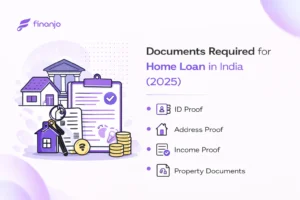
Overview: Home Loan Document Checklist
Use this quick table as a checklist. Collect these items first so the rest of the process becomes smooth.
| Document Name | Type | Why It Is Required | Who Needs It |
|---|---|---|---|
| PAN Card | KYC / Identity | Tax identity for credit checks and to link financial transactions | All applicants |
| Aadhaar Card | KYC / Address | Proof of identity and address; used for eKYC where available | All applicants (if available) |
| Passport | KYC / Identity | Alternate identity proof; mandatory for NRIs | NRIs and applicants without Aadhaar |
| Voter ID / Driving Licence | KYC / Identity / Address | Accepted government ID and address proof | All applicants (if available) |
| Passport-size photographs | KYC / Misc | For application forms, sanction paperwork and KYC | All applicants |
| Salary Slips (Last 3 months) | Income Proof (Salaried) | Verify current salary and employer relationship for EMI affordability | Salaried applicants |
| Form 16 / Tax Documents | Income Proof | Proof of annual income and tax-paid history used in eligibility | Salaried and self-employed |
| Bank Statements (Last 6–12 months) | Income Proof / Cashflow | Shows salary credits, business receipts and monthly cash flows | All applicants |
| ITR (Last 2–3 years) | Income Proof (Self-employed) | Proof of declared business income and tax compliance | Self-employed / Business owners |
| CA-certified P&L & Balance Sheet | Income Proof (Self-employed) | Detailed financials for underwriting and income computation | Self-employed / Business owners |
| GST Returns (if applicable) | Business Income Proof | Proof of turnover for GST-registered businesses | Self-employed / Businesses with GST |
| Agreement to Sale / Allotment Letter | Property Document | Evidence of seller’s commitment and payment terms | All applicants buying property |
| Sale Deed / Title Deed | Property Document | Proves seller’s ownership and valid title chain | All applicants |
| Encumbrance Certificate (EC) | Property Document / Legal | Shows the property is free from loans or legal claims for a given period | All applicants |
| Approved Building Plan & Sanction | Property Document / Regulatory | Ensures construction follows municipal approvals and laws | All applicants (especially new constructions) |
| Completion Certificate / Occupancy Certificate (CC / OC) | Property Document / Regulatory | Confirms building is completed and fit for occupation (for ready properties) | Buyers of ready-to-move-in properties |
| Property Tax Receipts | Property Document | Proof of payment and maintenance of local taxes | All applicants |
| No Objection Certificate (NOC) | Property Document / Consent | Required from society, builder or authority for transfer or financing | All applicants (where applicable) |
| Mutation / Khata / Jamabandi / Local Land Records | Property Document / Revenue | State-specific proof of ownership or assessment records | All applicants (as per state norms) |
| Cancelled Cheque / Bank Mandate | Additional | For EMI auto-debit and account verification | All applicants |
| Proof of Age (Birth certificate / Passport) | Additional / KYC | Age verification for eligibility and loan tenure | All applicants |
| Statement of Assets & Liabilities | Additional / Financial | Shows net worth and supports repayment capacity assessment | Often requested from self-employed / high-value loans |
| Power of Attorney (Notarised) | Additional / Legal | When a local person signs documents on applicant’s behalf (common for NRIs) | NRIs or applicants unable to sign in person |
| Passport + Valid Visa / Work Permit | NRI KYC | Overseas identity and legal status verification | NRIs |
| Overseas Bank Statements (Last 6 months) | NRI Income Proof | Proof of foreign salary or income for affordability | NRIs |
| NRE / NRO Account Proof | NRI Banking | Indian remittance and repayment account details | NRIs |
| OCI / PIO Card (if applicable) | NRI KYC | Indian nationality status documentation for certain benefits | NRIs with OCI / PIO |
What Types of Documents Do You Need for a Home Loan in India (2025)?
At a high level, banks and housing finance companies ask for four groups of documents:
- KYC and identity proofs (Aadhaar, PAN, passport, etc.)
- Income documents (salary slips, bank statements, ITRs)
- Property and title documents (sale deed, approved plan, encumbrance certificate)
- Other / additional documents (photos, consent forms, co-applicant documents)
Major lenders publish similar groupings in their checklists.
KYC and Identity Documents for Home Loan Application
Your lender must verify who you are and where you live. Typical accepted documents are:
- PAN card (often mandatory for financial transactions)
- Aadhaar card
- Passport
- Voter ID
- Driving licence
- Recent passport-size photographs (usually 2 to 4)
Use clear, government-issued IDs. Many lenders list PAN and Aadhaar first in their KYC checklists.
Income Proof Documents for Home Loan (Salaried & Self-Employed)
Income proof helps the lender estimate affordability and repayment capacity. The exact papers depend on your employment type.
Salaried applicants
- Last 3 months salary slips (some lenders ask for last 6 months)
- Form 16 for the previous 1 or 2 years (if available)
- Bank statements for the salary account for the last 3 to 6 months
- Employment letter or appointment confirmation (for new employees)
Most banks explicitly require salary slips and bank statements when assessing salaried borrowers.
Self-employed professionals and business owners
- Income Tax Returns (ITR) for the last 2 to 3 financial years (complete returns)
- Profit and Loss statement and balance sheet certified by a Chartered Accountant (for businesses)
- Bank statements for the business/current account for the last 6 to 12 months
- GST returns and business registration documents (where applicable)
Self-employed borrowers usually face stricter scrutiny and must submit audited financials or CA certificates.
Property Documents Required for Home Loan Approval
Property paperwork is the most critical and often the most time-consuming part. Lenders verify the title, approvals and tax status. Common property documents are:
- Agreement to Sale or allotment letter (from builder / seller)
- Sale deed / Title deed / Mother deed proving seller’s ownership
- Encumbrance Certificate (EC) showing the property is free from legal dues (often last 13 years requested)
- Approved building plan and sanctions from municipal authority
- Occupancy Certificate (OC) / Completion Certificate (CC) for ready properties
- Property tax receipts and receipts of payments to builder/society
- No Objection Certificate (NOC) from society, builder or relevant authority (if applicable)
- Mutation / Khata / Jamabandi or local land records depending on state
Top housing lenders and legal valuation teams require ECs, approved plans and title deeds before sanctioning loans to ensure there are no legal claims on the property. Some banks ask for prior deeds up to 13 years or more. You can check official bank websites.
Additional Documents & Co-Applicant Requirements for Home Loans
Besides the main sets above, lenders commonly ask for:
- Proof of age (birth certificate, passport)
- Proof of business (for self-employed) or appointment letters (for salaried)
- Statement of assets and liabilities (some lenders ask for a personal net-worth statement)
- Copies of cheques or cancelled cheque for loan account auto-debit
- Power of Attorney (if someone signs on your behalf)
- If applying with a co-applicant, similar KYC and income documents for the co-applicant
Always check whether the lender requires originals for verification or accepts scanned copies first—many lenders do an initial online scan and then ask for originals at sanction.
Documents Required for NRI Home Loans in India
NRIs follow a slightly different checklist because of overseas addresses and foreign income. Typical NRI documents include:
- Valid passport copy and visa / work permit
- OCI / PIO card if applicable
- Overseas bank statements (last 6 months) and NRE/NRO account details
- Salary slips or foreign tax returns / employer contract
- Power of Attorney (for a local representative, if required)
- Local Indian KYC: PAN (mandatory), Aadhaar (if available) or Indian address proof where needed
Major housing finance companies list overseas bank statements, passport and work visa as standard requirements for NRIs. Expect additional documentary checks for foreign income. See NRI notes: HDFC – NRI documents and SBI – NRI home loans.
How to Organise Documents for Home Loan Submission
Good organisation speeds up approval:
- Make two sets of clear photocopies for each document and keep originals ready for verification.
- Label documents by category: KYC, Income, Property, Others.
- For ITRs include acknowledgement (ITR-V) and computation of income certified by a CA for self-employed cases.
- For property papers, compile a single folder with sale deed, EC, approved plan, tax receipts and NOC if any.
- If you are an NRI, prepare notarised copies of overseas documents and translated versions if they are not in English.
Most banks will verify originals at the branch or during legal valuation; being organised reduces back-and-forth. See organisation tips: ICICI – Document checklist
Common Document Mistakes That Delay Home Loan Approval
- Incomplete property title chain — missing prior sale deeds or inconsistent names on deeds
- Poor-quality photocopies — faint scans or cropped pages
- Mismatch of name or spelling across identity, income and property documents
- Insufficient proof of business for self-employed borrowers (lack of audited accounts or CA certificate)
- Unpaid property taxes or missing NOC from society or builder
These are frequent reasons for legal checks and processing delays at the sanction stage. Address them proactively to reduce turnaround time.
Home Loan Typical Timeline: From Application to Disbursement
Timelines vary by lender and property complexity, but a typical flow is:
- Application & document submission: 1–3 days
- Credit and eligibility assessment: 3–7 days
- Property legal verification and valuation: 7–21 days (longer for complex titles)
- Loan sanction & completion of paperwork: 3–7 days after legal clearances
- Disbursement: As per agreement (single or staggered for construction loans)
Legal valuation and EC checks are usually the rate-limiting steps. Banks with digital processes and e-verification can be faster for straightforward cases.
State-Specific Notes & Property Records for Home Loan
Land records and property naming conventions differ across states (Khata, Jamabandi, Mutation, etc.). Always check local requirements (municipal or revenue records) for documents such as Khata or Mutation certificate. Lenders will ask for state-specific records when applicable.
Quick Home Loan Document Checklists
Checklist A — Salaried Applicant (Standard)
- PAN card copy
- Aadhaar card copy
- Passport-size photos (2–4)
- Last 3 months salary slips
- Form 16 (last 1–2 years)
- Bank statements (last 6 months)
- Employer ID/appointment letter
- Property: Agreement to Sale, Title deed, EC, approved plan, tax receipts, NOC (as applicable)
Checklist B — Self-Employed / Business Owner
- PAN card, Aadhaar
- ITRs (last 2–3 years) with ITR-V acknowledgements
- CA-certified P&L and balance sheet
- GST returns (if applicable)
- Business registration / incorporation docs
- Bank statements (last 6–12 months)
- Property documents as per Checklist A
Checklist C — NRI Applicant
- Passport copy with valid visa
- Overseas bank statements (6 months)
- Employment contract or salary slips
- OCI/PIO card (if applicable)
- Power of Attorney (if using a local representative)
- Indian KYC documents: PAN, Aadhaar (if available)
References and Official Bank links:
Conclusion
Preparing a complete, well-organised document set is the single best step you can take to speed up home loan approval. Start gathering KYC, income and property documents early, correct any mismatches in names and addresses, and consult the lender’s checklist before submission.
Leave a Reply