A PAN Card is one of the most important financial identity documents for individuals and businesses in India. Whether you are opening a bank account, filing income tax returns, investing, or applying for a loan, your PAN acts as a unique identifier that links all your financial transactions in one place. Issued by the Income Tax Department, the PAN Card helps the government track taxable income and prevents tax evasion. Beyond taxation, it has also become a mandatory document for many everyday financial activities, making it essential for students, salaried professionals, self-employed individuals, and businesses alike.
In this blog, we’ll explain everything about PAN Card its meaning, key uses, eligibility criteria, and the complete application process so you understand why it matters and how to get one easily.
It’s small enough to fit in your wallet, yet powerful enough to open bank accounts, file taxes, start a business, or invest in your future. Behind that simple 10-digit code lies your entire financial identity, neatly linked to your name, your date of birth, and even a tiny QR code that proves you are you.
Whether you’re a student opening your first bank account, an NRI managing money from afar, or a company registering for business your journey almost always begins with this one essential document.
The best part? It’s yours for life. One number, one identity, one gateway to every major financial move you’ll ever make.
PAN Card Overview
A PAN card isn’t just another government document, it’s the quiet backbone of your financial life in India. Issued by the Income Tax Department, Government of India, this small card holds a lot of power. It carries a unique 10-character code that becomes your financial identity from the moment you receive it, and it stays with you for life.
What Makes PAN Important?
- It carries a unique 10-character alphanumeric code valid for a lifetime.
- Acts as your financial passport for banking, investments, property deals, and tax filings.
- Ensures transparency and prevents duplication only one PAN is allowed per person or entity.
What Does a PAN Card Include?
- Name of the cardholder
- Father’s name
- Date of birth
- Photograph
- Signature
- QR code for instant verification
Who Needs a PAN Card?
- Indian citizens
- NRIs
- Minors (through guardians)
- Companies, firms, and trusts
- Foreign citizens involved in Indian financial activities
Where Is PAN Mandatory?
- Opening a bank account
- Filing income tax returns
- Buying or selling property
- High-value transactions
- Business registrations
A Quick Snapshot
- Who issues it? The Income Tax Department of India
- PAN Helpdesk: 020 – 27218080
- Introduced in: 1972
- Validity: Lifelong, no renewal, no expiry
- Cost: Anywhere between ₹66 to ₹1,017, depending on where the card is delivered
What is a PAN Card?
A PAN Card (Permanent Account Number) is one of the most important identity documents for anyone earning or investing money in India. Issued by the Income Tax Department, it contains a unique 10-digit alphanumeric number that becomes your permanent financial identity throughout your life.
Think of a PAN as your financial fingerprint, it stays the same forever and is used every time you file taxes, receive income, open a bank account, invest, or carry out high-value transactions. This helps the government track financial activities smoothly and ensures transparency for both individuals and businesses.
A PAN card includes your name, father’s name, date of birth, photograph, signature, and the distinct PAN number printed clearly on the front. It also carries the Government of India emblem along with a security hologram or QR code to verify authenticity.
You need a PAN for:
- Filing your income tax return
- Paying taxes and receiving TDS refunds
- Opening a bank or demat account
- Buying property, gold, or vehicles
- Making large deposits or investments
Since every PAN number is unique, no two people or entities can share the same number, which keeps your financial identity safe and traceable.
In simple words, a PAN card is your essential financial ID in India, lifelong, unique, and necessary for almost all major financial tasks.
PAN Card Contents
1. PAN Number:
This is your personal 10-character code, totally unique to you. It’s like your financial fingerprint. No one else has it, and it’s what connects your bank accounts, tax returns, and big financial moves to you.
2. Your Name:
Your full name as per official records. Pretty straightforward, but this ensures that all your transactions are linked to the right person you.
3. Father’s or Guardian’s Name:
For extra verification, the card shows your father’s name (or guardians, if you’re a minor). It just makes life easier when the government or banks want to double-check who you are.
4. Date of Birth / Incorporation:
If you’re an individual, it shows your date of birth. If it’s a company or trust, it shows the date of incorporation. Basically, it proves who or what the card belongs to.
5. Photo:
A tiny passport-sized photo so anyone can quickly see who the card belongs to.
6. Signature :
Your signature on the card is like your stamp of authenticity; it confirms that this card is really yours.
7. QR Code / Hologram:
This is the techy part. Scan it, and you can verify the card instantly. It also makes it super hard for anyone to fake it.
8. Government Logo:
The Government of India emblem shows that this is an official, legit card, not some random piece of plastic.
Decoding Your PAN Card: What Each Character Means
A PAN card isn’t just a random mix of letters and numbers; it’s like a tiny code that tells the government a bit about you. Every character has a story. Let’s break it down in a way that actually makes sense:
1. The First Three Letters
The PAN kicks off with three alphabets. They don’t reveal anything personal they’re just part of the unique code that makes your PAN different from everyone else’s.
2. The Fourth Letter: Who You Are
The fourth letter is important it tells the government what kind of taxpayer you are. Here’s the quick cheat sheet:
A – Association of Persons
B – Body of Individuals
C – Company
F – Firm
G – Government
H – Hindu Undivided Family (HUF)
L – Local Authority
J – Artificial Judicial Person
P – Individual
T – Trust
So, if you’re a regular person like most of us, that letter will always be P.
3. The Fifth Letter: Your Surname
The fifth character is the first letter of your surname. For example, if your last name is Sharma, this letter will be S. Pretty straightforward, right?
4. The Four Numbers
Next come four digits (0-9), randomly assigned. These numbers don’t have a secret meaning they just help make your PAN truly unique.
5. The Last Letter
Finally, there’s one last alphabet at the end. It’s the cherry on top that completes your unique PAN code.
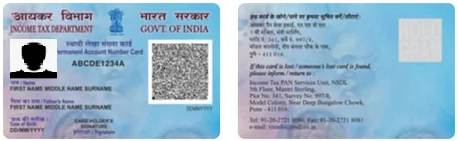
Image Source: Paisa Bazaar
PAN Card Form: Your First Step to Getting a PAN
Getting a PAN card doesn’t have to feel like boring paperwork. Think of it as your key to the financial world in India from opening a bank account to filing taxes or investing, everything starts with your PAN. And the first step? Filling out the right form.
1. Form 49A – For Indian Citizens
If you’re an Indian, whether living here or abroad you’ll use Form 49A. It’s the standard form for individuals and asks for things like your name, date of birth, address, and some ID proof. Pretty straightforward.
2. Form 49AA – For Foreign Citizens
If you’re a foreigner wanting a PAN to invest or do business in India, you’ll fill Form 49AA. It’s similar to 49A, but you’ll need documents like your passport and proof of address from your home country.
What You Need to Fill In
- Your full name and date of birth
- Father’s or guardian’s name (if you’re a minor)
- Residential or office address
- Phone number and email
- Proof of identity, address, and date of birth
How to Submit It
You’ve got two ways:
- Online: Go to the NSDL or UTIITSL website, upload scanned documents, pay the fee, and you’re done.
- Offline: Go to a PAN service center, fill the paper form, attach documents, pay, and submit.
Once it’s processed, your PAN card will be on its way, and you’ll have your permanent financial identity ready to use.
The PAN form might look boring, but it’s actually your first handshake with India’s financial system. Fill it carefully, submit the documents, and you’re one step closer to handling money like a pro!
PAN card eligibility
| Category | Eligibility / Requirement |
|---|---|
| Indian Citizens – Individuals | Salaried, self-employed, professionals with valid proof of identity and address. |
| Minors | Guardians/parents can apply on behalf of minors. Documents of minor’s date of birth must be submitted. |
| Hindu Undivided Families (HUFs) | Karta can apply; HUF is a separate legal entity for financial transactions. |
| Limited Liability Partnerships (LLPs) | Must apply to conduct financial transactions and file taxes. |
| Partnership Firms | Must obtain PAN in the firm’s name to file income tax returns. |
| Companies | Mandatory for all companies in India; PAN must be used in all financial transactions. |
| Trusts and Associations (AOP/BOI) | Can apply by submitting Certificate of Registration. |
| Local Authorities | Can apply by producing a copy of the agreement. |
| Artificial Judicial Persons | Can apply using Certificate of Registration or government document proving identity and address. |
| Foreign Citizens | Must apply if engaging in financial transactions in India; need identity, address, and date of birth proof. |
PAN Card Documents Requirements
| Applicant Type | Proof of Identity (POI) | Proof of Address (POA) | Proof of Date of Birth / Registration |
|---|---|---|---|
| Individual (Indian Citizen) | Aadhaar Card, Voter ID, Passport, Driving Licence, Ration Card (with photo), Govt Photo ID | Aadhaar Card, Passport, Voter ID, Driving Licence, Utility Bill (≤3 months), Bank Statement, Post Office Passbook | Aadhaar Card, Birth Certificate, Passport, Matriculation Certificate, Driving Licence |
| Company | Certificate of Incorporation | Registered Office Address Proof | Certificate of Incorporation |
| Partnership Firm | Partnership Deed | Firm Address Proof | Registration Certificate (if registered) |
| LLP | Certificate of Incorporation (LLP) | Registered Office Address Proof | Certificate of Incorporation |
| HUF | Identity Proof of Karta | Address Proof of Karta | Affidavit by Karta |
| Trust | Trust Deed | Trust Address Proof | Registration Certificate (if applicable) |
| AOP / BOI | Agreement / Registration Document | Address Proof of Entity | Registration Certificate |
| Foreign Citizen / NRI | Passport, OCI / PIO Card (if applicable) | Overseas Address Proof, Indian Address Proof (if available) | Passport |
PAN Card Fees
| Applicant Type | Mode of Application | PAN Card Type | Fees (₹) |
|---|---|---|---|
| Indian Citizen | Online / Offline | Physical PAN Card | ₹107 |
| Indian Citizen | Online | e-PAN (Digital PAN) | ₹72 |
| Foreign Citizen / NRI | Online / Offline | Physical PAN Card | ₹1,017 |
| Foreign Citizen / NRI | Online | e-PAN (Digital PAN) | ₹1,017 |
Important Notes
-
Fees include GST
-
e-PAN is delivered via email
-
Physical PAN card is dispatched to the registered address
-
Charges may vary slightly depending on the service provider
If you’ve misplaced your PAN card
don’t worry…getting a duplicate one is actually quite simple. You can apply online through either the NSDL or UTIITSL portal, and the process barely takes a few minutes.
Here’s how it works:
- Go to the NSDL or UTIITSL website and look for the option “Re-print PAN card” or “Duplicate PAN card.”
- Enter basic details like your PAN number, Aadhaar number, date of birth, GSTIN (if you have one), and the captcha.
- Submit the information and verify it through an OTP sent to your registered mobile or email.
- Make the payment online to complete the application.
- Once done, you’ll receive an acknowledgment number, which you can use to track your application status anytime.
- The physical card is usually delivered to your registered address within 15–20 days. If you need it urgently, you can also download an e-PAN instantly and use it while you wait for the printed card.
- The fees may differ depending on whether the delivery is within India or abroad.
Remember:
- A duplicate PAN card contains the same number and details as your original.
- If your PAN card is lost or stolen, it’s a good idea to file an FIR to avoid any misuse.
- Holding more than one PAN number is illegal, so if you discover multiple PANs issued in your name, you must surrender the extra one.
Overall, the entire process is quick, convenient, and can be completed online without changing any of your PAN details.
FAQs
1. How can I download my PAN card online?
You can download your e-PAN from either NSDL or UTIITSL.
Just enter your PAN + Aadhaar + OTP, and you can instantly download a soft copy (PDF). Make sure your mobile number is linked to Aadhaar.
2. I lost my physical PAN card. Can I re-download it?
Yes! If your email/phone is registered, you can re-download your e-PAN anytime.
If not, you may need to update your contact details first and then download it.
3. How do I check my PAN card status after applying?
Go to the NSDL/UTI portal → Click on “Track PAN Status” → Enter acknowledgement number.
You’ll see whether your PAN is under review, approved, printed, or dispatched.
4. How long does it take for a new PAN card to arrive?
Digital e-PAN comes in 24–48 hours after verification.
The physical card usually takes 10–15 working days depending on your location.
5. Can I apply for a PAN card with only Aadhaar?
Yes! You can apply for an Instant e-PAN using Aadhaar-based OTP.
This is the fastest method and perfect for students, new earners, or anyone without documents handy.
6. How do I correct mistakes in my PAN card (name, DOB, etc.)?
Use the “PAN Correction” form on NSDL or UTI.
You’ll need to upload supporting documents (Aadhaar, ID proof) and pay a small fee.
Corrections usually take 7–15 days.
7. I don’t remember my PAN number. How do I find it?
Just use the “Know Your PAN” service on the Income Tax website.
Enter your Aadhaar → Verify with OTP → Your PAN number appears instantly.
8. How can I update my photo, signature, or address in PAN?
These count as updates/corrections and should be done through the PAN correction form.
You’ll get a new updated PAN card once changes are approved.
9. Does updating Aadhaar automatically update PAN?
No, both systems are separate.
If you update Aadhaar, you must update PAN manually through NSDL/UTI.
10. Can I have more than one PAN card?
No! It’s illegal to hold multiple PANs.
If you accidentally have two, surrender the duplicate by filing a correction request or contacting the department.
Leave a Reply