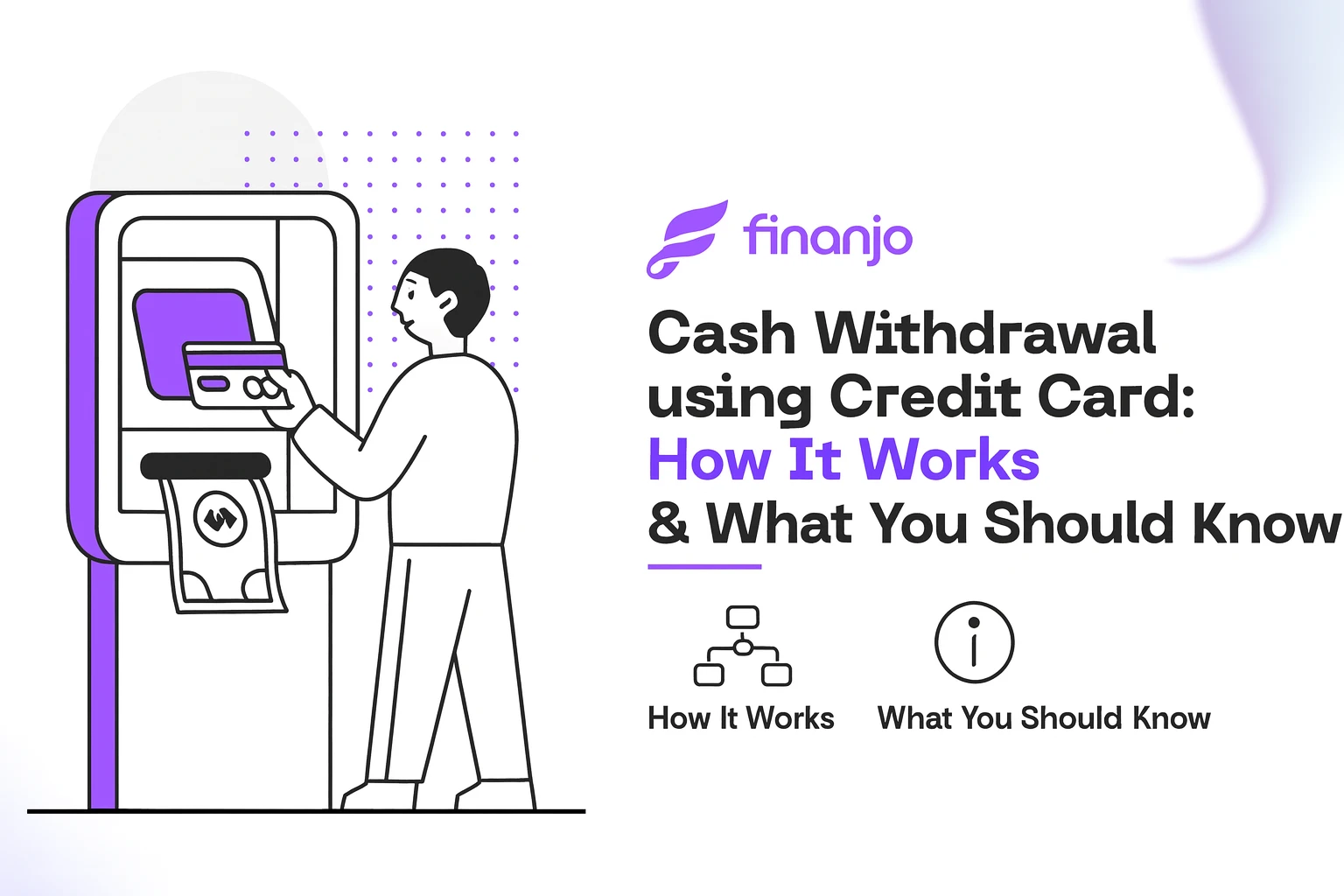
Similar to a debit card, the Cash Withdrawal Using Credit Card feature enables cardholders to take out cash from an ATM or bank branch using their credit card. Although it functions very differently from standard credit card purchases, this option can be helpful in times of financial emergency or urgent cash needs. Cash withdrawals are an expensive form of borrowing because they come with immediate interest, additional fees, and higher charges than regular card purchases. Before utilizing this feature, it is crucial to comprehend how credit card cash withdrawals operate, as well as their costs, limitations, and effects on your finances.
In this blog, we explain how cash withdrawal with a credit card works. We cover the fees, interest rates, withdrawal limits, effects on your credit score, and whether it is a safe choice.
What Is Cash Withdrawal Using a Credit Card?
Cash withdrawal using a credit card, also known as a credit card cash advance, is a facility that allows cardholders to withdraw cash from an ATM or, in some cases, directly from a bank branch using their credit card. The withdrawn amount is not free cash; it is treated as a short-term loan from the credit card issuer and is added to your outstanding credit card balance.
How Is It Different from Normal Credit Card Spending?
Unlike regular credit card transactions used for shopping or bill payments, cash withdrawal using a credit card does not come with an interest-free period. Interest starts accruing from the date of withdrawal itself. Additionally, banks charge a cash withdrawal fee and applicable GST, making it a more expensive option compared to normal card usage, where interest is charged only if you fail to pay the full bill on time.
Why Do Banks Allow Cash Withdrawal on Credit Cards?
In times of emergency, when other options might not be available, banks provide their customers instant access to cash through the cash withdrawal feature. By permitting restricted cash usage, it also gives credit cards more flexibility. However, in order to deter frequent use and guarantee responsible borrowing, banks impose lower withdrawal limits, higher interest rates, and additional fees due to the increased risk and expense involved.
How Does Credit Card Cash Withdrawal Work?
| Method | Process | Key Points |
|---|---|---|
| Cash Withdrawal via ATM |
|
The withdrawn amount is added instantly to your credit card bill, interest starts immediately, and cash withdrawal charges apply. |
| Cash Withdrawal at Bank Branch |
|
You may need to show a valid ID and your credit card. Availability varies by bank, and charges plus interest apply from the same day. |
Credit Card Cash Withdrawal Limit Explained
| Aspect | Explanation |
|---|---|
| Percentage of Total Credit Limit | Most banks allow cash withdrawal up to 20%–40% of your total credit limit. This means if your credit limit is ₹1,00,000, your cash withdrawal limit may range between ₹20,000 and ₹40,000. |
| Bank-Wise Limits (General Overview) | Cash withdrawal limits vary by bank and card type. Premium credit cards often have lower or restricted cash limits, while entry-level cards may allow a higher percentage. Banks also reserve the right to change limits based on your credit profile and usage history. |
| Daily Withdrawal Cap | Banks usually set a daily cap to limit risk. Even if your total cash limit is higher, you may only be able to withdraw a fixed amount per day. |
| Monthly Withdrawal Cap | Some banks also apply a monthly limit on cash withdrawals. Once this limit is reached, further cash withdrawals are blocked until the next billing cycle. |
How to Avoid Charges on Credit Card Cash Withdrawal?
Credit card cash withdrawals usually come with a fee that amounts to a certain percentage of the withdrawn amount, typically 2.50% to 3%, plus high interest that starts accruing immediately. Here are a couple of ways you can reduce the amount of charges you pay for credit card cash withdrawals.
How Much Will You Pay?
Let’s take two examples to understand Credit Card Cash Withdrawal charges –
Example 1: ₹10,000 withdrawal, repaid in 10 days
- Cash advance fee: 2.5% of ₹10,000 = ₹250, but minimum fee might be ₹500 → you pay ₹500.
- Interest: Suppose the monthly rate is 3%. Daily rate = 3% ÷ 30 = 0.1%. For 10 days: 10,000 × 0.1% × 10 = ₹100.
- Total cost ≈ ₹600.
Example 2: ₹25,000 withdrawal, repaid in 30 days
- Cash advance fee: 2.5% of ₹25,000 = ₹625 (above minimum).
- Interest: Daily rate 0.1%, for 30 days = 25,000 × 0.1% × 30 = ₹750.
- Total cost ≈ ₹1,375.
You can see how fees and interest quickly add up, almost 5.5% more in this example.
Use a Credit Card with No Cash Advance Fee
The best way to avoid credit card cash withdrawal fees is to have a card that does not charge you for cash withdrawals, though such cards are usually premium or have high annual fees. Some cards offer lower cash withdrawal fees with a nominal annual fee, like certain Kotak or Axis variants promoted in the market.
Examples of credit cards with minimal or no cash withdrawal fees are listed here (terms may change; always check the most recent issuer schedule).
| Credit Card | Cash Withdrawal Fees | Annual Fee |
|---|---|---|
| Kotak Fortune Gold Credit Card | Rs.199 per Rs.10,000 withdrawn (illustrative) | Rs.0 |
| Axis Bank Magnus Credit Card | Rs.0 (on some variants) | Rs.10,000 |
| Yes Private Prime Credit Card | Rs.0 (on some variants) | Rs.10,000 |
| ICICI Emerald Credit Card | 1.99% of the withdrawn amount, subject to a minimum of Rs.300 | Rs.12,000 |
| Axis Bank Burgundy Private Credit Card | Rs.0 (on some variants) | Rs.50,000 |
| Axis Bank Reserve Credit Card | Rs.0 (on some variants) | Rs.50,000 |
Pros and Cons of Cash Withdrawal through Credit Card
The following are the pros and cons of the cash withdrawal option. Before you use your credit card at the nearest ATM, take a moment to think about these factors.
| Pros | Cons |
| No documentation or approval required. | Interest will be charged from the date of transaction till the payment is made in full. |
| Provides immediate cash as ATMs are accessible 24×7. | A cash advance fee will be levied on every transaction. |
| Access to flexible limits within your cash limit. | Transactions involving cash advances are not eligible for most credit card reward points. |
Charges on Cash Withdrawal Using Credit Card
| Type of Charge | Details |
|---|---|
| Cash Withdrawal Fee | Banks charge a cash withdrawal fee that is either a flat amount or a percentage of the withdrawn amount. Typically, this ranges from 2% to 3% of the withdrawn amount, subject to a minimum charge (for example, ₹300–₹500 per transaction). |
| Interest on Cash Withdrawal | Unlike regular credit card spending, interest starts immediately from the date of withdrawal, as there is no interest-free period. In India, the interest rate on cash withdrawal generally ranges between 30% and 45% per annum, depending on the bank and card type. |
| GST on Fees and Interest | GST is applicable on cash withdrawal charges and the interest amount charged by the bank. This further increases the overall cost of withdrawing cash using a credit card. |
Impact of Cash Withdrawal on Credit Score
Cash withdrawal using a credit card can indirectly affect your credit score if not managed carefully. One of the main factors is the credit utilization ratio; since cash withdrawals use a part of your credit limit, they increase your outstanding balance quickly, and a higher utilization especially above 30% can negatively impact your score.
Another major risk is missed or delayed payments. Because interest starts immediately on cash withdrawals, the outstanding amount can grow faster than expected; if you fail to pay dues on time or only make minimum payments, it may lead to late payment charges and negative reporting to credit bureaus.
Your credit score is impacted negatively when cash withdrawals become frequent, utilization remains high for long periods, or payments are missed, as lenders read this as financial stress.
Is Cash Withdrawal Using a Credit Card Safe?
From a technical standpoint, cash withdrawal using a credit card is safe when done at secure and trusted ATMs, as banks use PIN verification, EMV chips, and alerts to reduce fraud.
However, there is a high risk of overspending. Easy access to cash can encourage unnecessary withdrawals, leading to higher interest costs and repayment pressure, and cash use is harder to track than digital payments.
Cash withdrawal using a credit card is best reserved for genuine emergencies when no other funds are available and you are confident of repaying quickly; it becomes risky when used regularly or for non-essential expenses, as it can quickly lead to debt accumulation and credit score damage.
When Should You Use Credit Card Cash Withdrawal?
Credit card cash withdrawal should be considered only as a last-resort option. It is most suitable in emergency situations, such as urgent medical needs or unexpected expenses, where immediate cash is required and no other option is available.
It can also be used for a short-term cash requirement when you are confident that you can repay the withdrawn amount quickly, because interest starts immediately and compounds daily.
Cash withdrawal using a credit card may make sense when no debit card balance, savings, or instant loan option is available, but even then the amount should be kept to the minimum necessary to reduce interest and charges.
Better Alternatives to Credit Card Cash Withdrawal
Before using your credit card to withdraw cash, it’s a good idea to look for cheaper and safer options.
- Debit card ATM withdrawal is the simplest and most cost-effective option, as it allows you to withdraw your own money without paying interest or high fees.
- A personal loan is better for larger or planned expenses, typically offering lower interest rates and structured EMIs instead of immediate high-interest debt.
- Credit card EMI or loan on card can convert big spends into EMIs at comparatively lower rates than cash advances.
- Bank overdraft facilities often carry lower rates than cash advances and offer flexible repayment.
Tips to Reduce Charges on Credit Card Cash Withdrawal
If you need to take out cash using your credit card, following a few smart habits can help lower the overall cost.
- Always withdraw the minimum amount required, since fees and interest are calculated on the withdrawn amount.
- Repay the withdrawn amount as early as possible to cut the number of days on which interest is charged.
- Before withdrawing, check your bank’s specific charges and interest rates, because these vary across banks and card types.
- Avoid repeated cash withdrawals, as multiple transactions mean multiple fees and higher accumulated interest.
FAQs on Cash Withdrawal Using Credit Card
1. Can I withdraw cash from a credit card at any ATM?
Ans: You can withdraw cash from most ATMs that accept your card network, provided your card has cash withdrawal enabled and you have a valid PIN; fees and interest will apply.
2. Is there any interest-free period on cash withdrawal?
Ans: No. Credit card cash withdrawals do not come with an interest-free period; interest starts from the transaction date.
3. Does cash withdrawal affect credit score?
Ans: It can, mainly by increasing your credit utilisation and by leading to missed or high repayments if not managed well.
4. Can I withdraw cash using a credit card without charges?
Ans: In practice, banks always apply interest and usually a fee on cash advances; “zero-fee” cards may waive the fee but still charge interest.
5. How much cash can I withdraw using my credit card?
Ans: The cash withdrawal limit is usually 20%–40% of your total credit limit, subject to daily and monthly caps set by your bank.
6. Is credit card cash withdrawal allowed internationally?
Ans: Many cards allow international cash withdrawal, but foreign transaction fees, dynamic currency conversion, and higher charges may apply.
Conclusion
Cash withdrawal using a credit card works like a short-term loan where the withdrawn amount is added to your card balance immediately and starts attracting interest from day one. While it offers quick access to cash, it comes with high fees, immediate interest, and potential impact on your credit score, so it should be used only when unavoidable and for genuine emergencies.
Always explore cheaper alternatives first and, if you do withdraw, compare charges, interest rates, and limits across banks and repay as soon as possible to stay financially safe.
Leave a Reply