Fixed Deposits have always been a go-to option for people who don’t like taking risks with their money. They’re simple, stable, and give you a clear idea of how much you’ll earn and when. That sense of certainty is exactly why so many people trust FDs, whether they’re saving for the first time or just want a safe place to park their money.
But putting all your savings into one single FD isn’t always the best move. This is where Fixed Deposit laddering makes things a bit smarter. Instead of locking everything away at once, you spread your money across multiple FDs with different maturity dates. It helps you stay liquid when you need cash, take advantage of better interest rates over time, and still enjoy the safety that fixed deposits are known for.
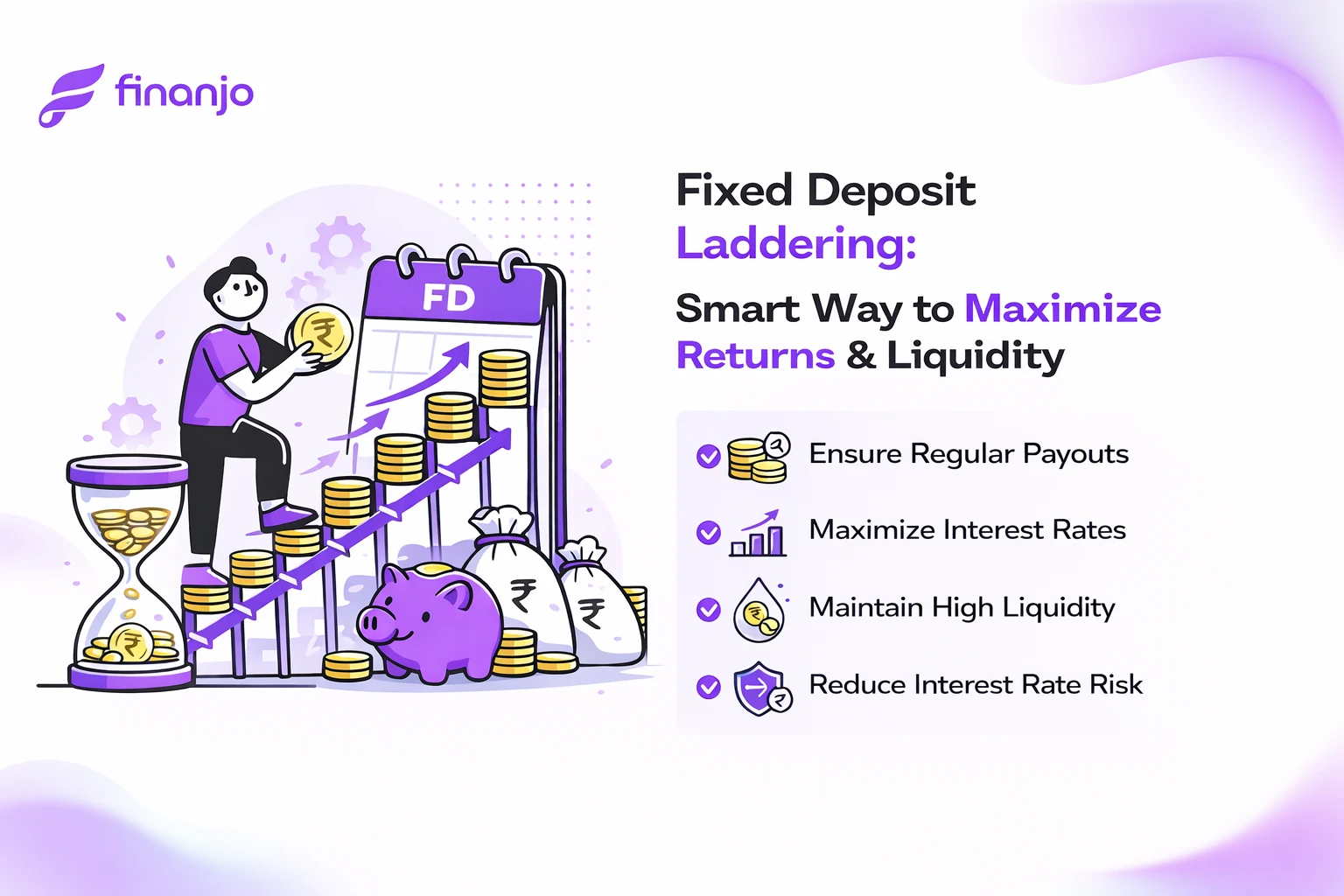
FD laddering is basically a more thoughtful way to use fixed deposits.
Instead of putting all your money into one FD and locking it away for years, you break the amount into smaller chunks. Each chunk goes into a separate FD with a different maturity time maybe one ends in a year, another in two, another in three.
Your money becomes available in phases instead of all at once. When one FD matures, you can use the cash if you need it or roll it into a new FD at the interest rate available then. It keeps things flexible while still staying safe.
How Does FD Laddering Work?
Step 1: Decide how much you want to invest
Start by fixing the total amount you’re comfortable putting into fixed deposits. This could be your savings, a lump sum, or money you don’t need immediately.
Step 2: Break the amount into smaller parts
Instead of putting the full amount into one FD, divide it into equal portions. This helps you avoid locking all your money for the same time period.
Step 3: Choose different FD tenures
Invest each portion in a fixed deposit with a different maturity period. For example, one FD for 1 year, another for 2 years, another for 3 years, and so on. Each FD will mature at a different time.
Step 4: Let the ladder start working
As time passes, your FDs will mature one after another. This gives you access to money at regular intervals rather than waiting for one long-term FD to end.
Step 5: Decide what to do at maturity
When an FD matures, you have two options. If you need the money, you can withdraw it without breaking any other FDs. If you don’t need it, you can reinvest it into a new FD, usually for the longest tenure in your ladder.
Step 6: Benefit from changing interest rates
By reinvesting matured FDs, you get a chance to lock in better interest rates if rates go up in the future. At the same time, part of your money is always earning interest.
Step 7: Repeat the process
Over time, this cycle continues. One FD keeps maturing every year, giving you flexibility, steady returns, and better control over your money all without giving up the safety of fixed deposits.
Example of FD Laddering (With Numbers)
FD Laddering Example
- Total Investment: ₹5,00,000
- FD Split: ₹1,00,000 each
- Interest Rate: 7% p.a.
| FD Amount | Tenure | Interest Rate | Maturity Value | Maturity Year |
|---|---|---|---|---|
| ₹1,00,000 | 1 year | 7% | ₹1,07,000 | End of Year 1 |
| ₹1,00,000 | 2 years | 7% | ₹1,14,490 | End of Year 2 |
| ₹1,00,000 | 3 years | 7% | ₹1,22,504 | End of Year 3 |
| ₹1,00,000 | 4 years | 7% | ₹1,31,074 | End of Year 4 |
| ₹1,00,000 | 5 years | 7% | ₹1,40,255 | End of Year 5 |
How it works year by year:
Year 1:
- The 1-year FD matures: ₹1,07,000.
- You can use the money if needed or reinvest it into a new FD at current interest rates.
- The remaining FDs are still locked in for their respective tenures.
Year 2:
- The 2-year FD matures: ₹1,14,490.
- You now have two options again: withdraw or reinvest.
- You still have FDs maturing in Years 3, 4, and 5.
Year 3:
- The 3-year FD matures: ₹1,22,504.
- At this point, you have more flexibility with cash while the remaining FDs continue earning.
Year 4:
- The 4-year FD matures: ₹1,31,074.
- You now have access to most of your investment while the last FD is still running.
Year 5:
- The 5-year FD matures: ₹1,40,255.
All original FDs are now matured, giving you full access to your ₹5 lakh + total interest earned over the years.
Total Interest Earned:
- Year 1 FD: ₹7,000
- Year 2 FD: ₹14,490
- Year 3 FD: ₹22,504
- Year 4 FD: ₹31,074
- Year 5 FD: ₹40,255
Total = ₹1,15,323
Benefits of this FD Ladder
- You get cash every year without breaking other FDs.
- You can reinvest at new interest rates if rates rise.
- Money stays safe and steadily growing, with flexibility built in.
Why FD Laddering is Better Than a Single FD
| Feature | Single FD | FD Laddering |
|---|---|---|
| Tenure | Locked for the full term | Split into multiple FDs with different maturities |
| Liquidity | Limited you can’t access money without penalty | Regular payouts as each FD matures |
| Interest Rate Risk | You’re stuck with the rate at the time of investment | Can reinvest matured FDs at current rates to benefit from higher rates |
| Flexibility | [Low]difficult to adjust if your needs change | [High]you can use or reinvest money as needed |
| Cash Flow | Only at the end of the tenure | Every year (or as per ladder) you get access to part of your money |
Key Benefits of FD Laddering
1. Better Liquidity
- Your investment is divided into multiple FDs with different maturities.
- You don’t have to wait for the entire amount to mature to access funds.
- Every year (or as per your ladder setup), one FD matures, giving you cash when you need it.
- This makes it easier to handle emergencies or unexpected expenses without breaking other deposits.
2. Reduced Interest Rate Risk
- When an FD matures, you can reinvest it at the current market interest rate.
- If interest rates rise, you earn more on new deposits instead of being stuck with a lower rate.
- Helps balance your returns over time instead of locking all money at one rate.
- Minimizes the risk of losing potential income due to falling or rising rates.
3. Stable & Predictable Returns
- FDs are inherently safe, offering fixed returns, and laddering keeps that stability intact.
- You know exactly when each FD will mature and how much interest it will generate.
- Ideal for conservative investors or those planning for regular income, like retirees.
- Reduces dependence on volatile investments while still keeping returns consistent.
4. Encourages Financial Discipline
- Spreading money across FDs encourages a long-term saving habit.
- You avoid the temptation to spend a large lump sum at once since each portion is locked temporarily.
- Offers a structured approach to savings without fully locking all your money.
- Helps you plan cash flow and reinvestment systematically over time.
Who Should Use FD Laddering?
1. Retired Individuals
People who’ve retired usually want a steady income without taking risks. FD laddering works well for them because it gives regular payouts every year to cover day-to-day expenses, while keeping their money safe.
2. Salaried Employees
If you earn a regular salary and want to save some money safely, FD laddering can be a good option. It lets you plan for both short-term needs and long-term goals. Plus, when one FD matures, you can use the money for emergencies or upcoming expenses without touching the rest.
3. Risk-Averse Investors
Some people just don’t like taking risks and prefer predictable returns. FD laddering suits them perfectly—it keeps their capital safe while giving steady interest. It’s a way to grow money without worrying about market ups and downs.
4. People Planning Regular Expenses
If you’re saving for things like tuition fees, rent, EMIs, or yearly trips, laddering makes life easier. You can time your FDs so they mature right when you need the money, helping you plan better and avoid any last-minute cash crunch.
FD Laddering vs Recurring Deposit (RD)
| Feature | FD Laddering | RD |
|---|---|---|
| Investment Type | You invest a lump sum upfront, then split it across FDs with different tenures | You put in a fixed amount every month |
| Liquidity | Higher: you get regular payouts as each FD matures | Lower: money is locked until the RD ends |
| Interest Rate Flexibility | Yes, when an FD matures, you can reinvest at current rates | Limited, the RD interest rate is fixed when you start |
Taxation on FD Laddering
1. Interest Earned is Taxable
- Every FD, whether part of a ladder or a single FD, earns interest.
- This interest is fully taxable under “Income from Other Sources”.
The rate of tax depends on your income slab:
- If you fall in the 5% slab, you pay 5% on the interest.
- If you fall in the 30% slab, you pay 30% on the interest.
- Even if you don’t withdraw the interest, it is taxable for that financial year.
2. TDS (Tax Deducted at Source)
- Banks are required to deduct TDS at 10% if the interest from FDs in a year exceeds ₹40,000 (₹50,000 for senior citizens).
- If your total income is below the taxable limit, you can submit Form 15G/15H to avoid TDS.
- TDS is not the final tax you still need to declare FD interest in your income tax return and pay any additional tax as per your slab.
3. Tax-Saving FDs
These FDs qualify for Section 80C deduction up to ₹1.5 lakh per year.
Key points:
- Minimum lock-in of 5 years cannot break before maturity.
- Interest is taxable even though the principal qualifies for deduction.
- Not suitable for liquidity in laddering, since you can’t break them early.
Risks & Limitations
- Returns are fixed and may not beat inflation, so your money could lose buying power.
- Tax reduces effective returns a 7% FD might give under 5% after tax if you’re in a high bracket.
- Not meant for aggressive wealth creation best for safety and steady income, not high growth.
Frequently Asked Questions (FAQs) on FD laddering
1. What’s FD Laddering all about?
It’s basically splitting your money into multiple FDs with different maturity dates, so you get some cash coming back at different times instead of locking it all away.
2. Why do people go for FD Laddering?
It’s a neat way to stay flexible. You get steady returns but also some money becoming available regularly, which you can reinvest or use as needed.
3. How do I set up a ladder?
Decide how much you want to put in, divide it into chunks, and open FDs for different time frames like 1 year, 2 years, 3 years so they mature one after the other.
4. Can I break an FD in the ladder early?
Yes, you can. But the bank usually gives less interest if you withdraw early, so it’s better to plan for the FDs you might need soon.
5. What about taxes on FD interest?
All interest you earn is taxable according to your income slab. Even if you leave it in the FD, you still need to pay tax for that year.
6. Do banks deduct TDS on these FDs?
Yep. If your interest in a year goes over ₹40,000 (₹50,000 for seniors), the bank will deduct 10% as TDS. If your total income is below the tax limit, you can submit Form 15G/15H to avoid it.
7. Can tax-saving FDs be part of a ladder?
You can, but remember they have a 5-year lock-in and the interest is still taxable. They help save tax, but you can’t touch the money early.
8. Will FD Laddering beat inflation?
Not really. FDs give fixed returns, so if inflation is high, your money’s buying power might actually drop a bit.
9. Is it good for building big wealth?
FD Laddering is safe and steady, but it won’t make you rich fast. For big growth, you’d need riskier stuff like stocks or mutual funds.
10. How do I keep track of multiple FDs?
Keep a small record note down the principal, maturity date, interest rate, and taxes. Makes it super easy to know what’s coming up and plan the next steps.
Leave a Reply