Recurring Deposit (RD) is a safe savings option where you deposit a fixed amount every month and earn interest on it. At maturity, you get back your total deposits plus interest. Since RDs give guaranteed returns, they are popular among salaried and small savers. To know your exact maturity value, you must understand how to calculate RD interest. In this guide, we explain the RD calculation formula, share examples, and why using an RD Calculator online makes it simple.
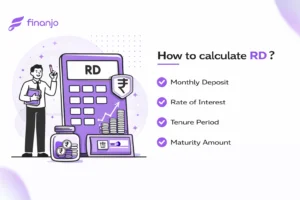
Overview of RD Calculation
| Factor | Details |
|---|---|
| Investment Type | Monthly deposits of a fixed amount |
| Tenure | 6 months to 10 years |
| Interest Rate | Bank/NBFC decides (usually 5%–8% p.a.) |
| Compounding | Quarterly (most banks) |
| Best Use | Disciplined monthly savings with assured returns |
RD Calculation Formula
RD interest is calculated using compound interest, as deposits are made every month and interest is added quarterly. The formula is:
M = P × [(1 + r/n)(n×t) – 1] ÷ (1 – (1 + r/n)–1/3)
- M = Maturity Value
- P = Monthly installment
- r = Annual interest rate (in decimal)
- n = Number of compounding periods per year (quarterly = 4)
- t = Tenure in years
Since the formula looks complicated, most people prefer using an RD Calculator online, which instantly shows the maturity value.
Examples of RD Calculation
Case 1: ₹5,000 per month for 2 years
Monthly Deposit = ₹5,000
Tenure = 2 years (24 months)
Rate = 6% p.a. (quarterly compounding)
Maturity Value ≈ ₹1,28,000
(Your investment = ₹1,20,000, Interest earned ≈ ₹8,000)
Case 2: ₹10,000 per month for 5 years
Monthly Deposit = ₹10,000
Tenure = 5 years (60 months)
Rate = 7% p.a. (quarterly compounding)
Maturity Value ≈ ₹7,20,000
(Your investment = ₹6,00,000, Interest earned ≈ ₹1,20,000)
Case 3: ₹2,000 per month for 3 years
Monthly Deposit = ₹2,000
Tenure = 3 years (36 months)
Rate = 6.5% p.a.
Maturity Value ≈ ₹78,000
(Your investment = ₹72,000, Interest earned ≈ ₹6,000)
RD Maturity Table (₹5,000 per month)
| Tenure | Rate of Interest | Total Investment | Maturity Value | Interest Earned |
|---|---|---|---|---|
| 1 Year | 6% | ₹60,000 | ₹61,800 | ₹1,800 |
| 3 Years | 6.5% | ₹1,80,000 | ₹1,94,000 | ₹14,000 |
| 5 Years | 7% | ₹3,00,000 | ₹3,60,000 | ₹60,000 |
Why Use an RD Calculator?
Since RD involves monthly deposits and quarterly compounding, manual calculations are time-consuming. An RD Calculator Tool is useful because it:
- Shows exact maturity value instantly
- Separates total investment and interest earned
- Handles different interest rates and tenures
- Saves time compared to manual formulas
Try our Free RD Calculator Tool to calculate RD maturity instantly.
Key Points to Remember for RD
- RDs are low-risk and ideal for disciplined savings.
- Interest is compounded quarterly in most banks.
- Premature withdrawal may lead to penalty and reduced interest.
- RD interest is fully taxable under “Income from Other Sources.”
- Senior citizens usually get higher RD interest rates.
FAQs on RD Calculation
Q1. How is RD maturity calculated?
RD maturity is calculated using compound interest on monthly installments. Since deposits are made every month, interest is added quarterly, making manual calculation complex. Online RD calculators give instant results.
Q2. Which is better – FD or RD?
FD is suitable if you have a lump sum to invest, while RD is ideal if you want to save monthly in smaller amounts. Both give assured returns, but FD may offer slightly higher rates for longer tenures.
Q3. Is RD interest taxable?
Yes, RD interest is taxable as per your income tax slab. Banks also deduct TDS if annual interest exceeds ₹40,000 (₹50,000 for senior citizens).
Q4. Can I withdraw RD before maturity?
Yes, but premature withdrawal usually comes with penalties and lower interest. Some banks may allow partial withdrawals, but it’s better to check terms before investing.
Q5. How much will I get if I invest ₹5,000 monthly in RD for 5 years?
At 7% interest, you will invest ₹3,00,000 and receive about ₹3,60,000 at maturity — earning ~₹60,000 as interest.
Recurring Deposits (RDs) are a disciplined way to save every month and build a safe corpus with guaranteed returns. By learning how to calculate RD using the formula and examples, you can plan better for future goals. For quick and accurate results, always use an RD Calculator online to check your maturity instantly.
Q6. Does RD interest rate remain fixed for the entire tenure?
Yes. Once you open an RD, the interest rate remains fixed for the chosen tenure, even if bank rates change later.
Q7. Is there a minimum amount required to open an RD?
Most banks allow you to start an RD with as little as ₹500 per month. The exact minimum may vary from bank to bank.
Q8. What happens if I miss an RD installment?
Banks usually charge a small penalty for missed installments. Repeated defaults may lead to lower maturity value or closure of the RD.
Q9. Can I open multiple RD accounts at the same time?
Yes. You can open multiple RDs with different amounts and tenures to plan for various financial goals.
Q10. Is RD better than a savings account?
RD generally offers higher interest than a savings account and helps build disciplined savings, while a savings account offers easy liquidity.
Leave a Reply