Goods and Services Tax (GST) is India’s indirect tax that applies to the supply of goods and services. Introduced in 2017, GST replaced multiple taxes like VAT, excise, and service tax, bringing them under one unified system. With the launch of GST 2.0 reforms effective from 22 September 2025, the structure has been simplified further. Certain slabs have been revised, and some merged to make compliance easier for both businesses and consumers.
Knowing how to calculate GST is essential – whether you are a shopkeeper billing a customer, a consumer checking product prices, or a business filing GST returns. In this guide, we explain GST slabs (old vs new), show the GST calculation formulas, provide examples with cases, and highlight why using a GST Calculator online saves time and prevents errors.
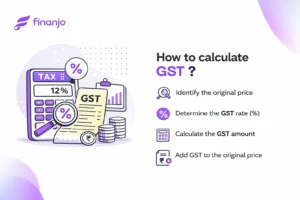
GST Slabs: Old vs New (2025)
GST is levied in slabs, depending on the type of goods and services. After GST 2.0, the structure is simpler:
| Old GST Slabs (Before 22 Sept 2025) | New GST Slabs (From 22 Sept 2025) |
|---|---|
| 0% – Essential goods/services | 0% – Essential goods/services |
| 5% – Daily use items | 5% – Essentials & household goods |
| 12% – Certain goods/services | 18% – Standard rate (merged with old 12%) |
| 18% – Standard goods & services | 18% – Continued as standard slab |
| 28% – Luxury & sin goods | 40% – New high slab for luxury & sin goods |
Note: Old rates apply for invoices and supplies made before 22 September 2025. New rates apply for all sales and services on or after this date.
GST Calculation Formula
GST can be calculated in two different ways, depending on whether the price is exclusive of GST or inclusive of GST.
1. GST Exclusive (Add GST on Base Price)
If the base price is given and you need to add GST:
GST Amount = (Base Price × GST%) ÷ 100
Final Price = Base Price + GST Amount
2. GST Inclusive (Price Already Includes GST)
If the price shown already includes GST and you need to find the base value:
Base Price = (Inclusive Price × 100) ÷ (100 + GST%)
GST Amount = Inclusive Price − Base Price
Examples of GST Calculation
Case 1: GST Exclusive (Old Slab – 18%)
Base Price = ₹1,000
GST = 18%
GST Amount = (1000 × 18) ÷ 100 = ₹180
Final Price = ₹1,180
Case 2: GST Inclusive (New Slab – 18%)
Final Price = ₹1,180
GST Rate = 18%
Base Price = (1180 × 100) ÷ 118 = ₹1,000
GST Amount = ₹180
Case 3: Luxury Good (New Slab – 40%)
Base Price = ₹50,000
GST = 40%
GST Amount = ₹20,000
Final Price = ₹70,000
GST Calculation Comparison Table
Here’s how a base price of ₹1,000 is taxed under old vs new GST slabs:
| GST Rate | Old Slab – GST Amount | Old Slab – Final Price | New Slab – GST Amount | New Slab – Final Price |
|---|---|---|---|---|
| 5% | ₹50 | ₹1,050 | ₹50 | ₹1,050 |
| 12% → merged into 18% | ₹120 | ₹1,120 | ₹180 | ₹1,180 |
| 18% | ₹180 | ₹1,180 | ||
| 28% → shifted to 40% | ₹280 | ₹1,280 | ₹400 | ₹1,400 |
Why Use a GST Calculator?
While GST formulas are simple, real-life billing often involves multiple products with different slabs, discounts, and inclusive/exclusive pricing. Manually calculating every invoice can lead to errors. A GST Calculator Tool helps by:
- Quickly checking GST-inclusive and exclusive values
- Handling multiple GST slabs (old and new)
- Avoiding mistakes in billing and invoicing
- Saving time for businesses and accountants
Try our Free GST Calculator Tool to calculate GST instantly.
Key Points to Remember while calculating GST
- The old 12% and 28% slabs are removed; the structure is now 0%, 5%, 18%, and 40%.
- Old rates continue only for invoices dated before 22 September 2025.
- MRPs of unsold goods may need revision with new GST stickers.
- Businesses must update billing software to reflect GST 2.0 changes.
FAQs on GST Calculation
Q1. What are the new GST slabs in 2025?
The GST slabs from 22 September 2025 are 0%, 5%, 18%, and 40% (for luxury and sin goods). The older 12% slab is merged into 18%, and 28% is shifted to 40%.
Q2. Do old GST rates still apply?
Yes, old GST rates apply for transactions, invoices, or payments made before 22 September 2025. From that date onwards, only the new GST 2.0 rates are applicable.
Q3. How to calculate GST on a product?
If the base price is ₹1,000 and the GST rate is 18%, the GST amount is ₹180. The final price you pay will be ₹1,180. This is GST-exclusive calculation.
Q4. How do I find GST from inclusive price?
If a price already includes GST, use this formula: Base Price = (Inclusive Price × 100) ÷ (100 + GST%). The difference between inclusive price and base price is the GST amount.
Q5. Is GST included in MRP?
Yes, the MRP printed on products is always inclusive of GST. Consumers don’t need to add anything extra to the MRP at retail counters.
Q6. Can businesses claim GST back?
Yes, registered businesses can claim Input Tax Credit (ITC) on the GST paid for purchases, which can be set off against their GST liability on sales.
With GST 2.0 reforms, India has moved to a simpler tax structure with slabs of 5%, 18%, and 40%. While this reduces confusion in the long run, invoices before 22 September 2025 may still reflect old rates. By learning how to calculate GST under both systems, businesses and consumers can ensure accurate billing. For quick and error-free results, use an online GST Calculator to check tax amounts instantly.
Q7. What is GST and how is it calculated?
GST is a tax charged on goods and services. It is calculated as a percentage of the product or service value.
GST Amount = Price × GST Rate ÷ 100
Q8. How do I calculate the final price including GST?
Add the GST amount to the original price.
Final Price = Original Price + GST Amount
Q9. How do I calculate GST if the price already includes tax?
You need to extract GST from the total price.
GST Amount = (Inclusive Price × GST Rate) ÷ (100 + GST Rate)
Q10. What are the common GST rates in India?
The common GST slabs are 5%, 12%, 18%, and 28%, depending on the product or service.
Q11. What is CGST and SGST in GST calculation?
For sales within the same state, GST is split equally into CGST and SGST.
Example: If GST is 18%, then 9% CGST + 9% SGST.
Q12. What is IGST and when is it applied?
IGST is charged on inter-state sales or imports.
The full GST rate is charged as IGST instead of splitting.
Q13. Can GST be calculated on discounts?
Yes. GST is calculated on the price after discount, not on the original price.
Q14. How do businesses calculate GST on multiple items in a bill?
GST is calculated item-wise based on each item’s applicable GST rate, then added together.
Q15. Is GST calculated before or after adding other charges?
GST is usually calculated after adding charges like packing or service fees if they are part of the supply.
Q16. What happens if I calculate GST wrongly?
Wrong GST calculation can lead to extra payment or penalties, so it’s important to check rates and calculations carefully.
Q17. Can I use a GST calculator instead of manual calculation?
Yes. Online GST calculators make calculation quick and reduce errors.
Q18. Does GST apply to all goods and services?
No. Some items are GST-exempt or taxed at 0%, like certain essential goods and services.
Leave a Reply