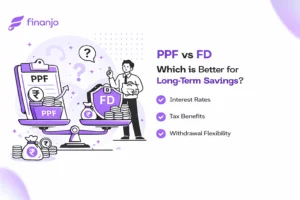
When it comes to safe investment options in India, two of the most popular choices are the Public Provident Fund (PPF) and Fixed Deposit (FD). Both are considered safe and guarantee returns, but they work differently in terms of returns, tax benefits, lock-in period, and withdrawal rules. Let’s compare PPF vs FD to understand which is better for long-term savings.
What is PPF (Public Provident Fund) ?
- A government-backed savings scheme with a 15-year lock-in.
- Current interest rate: ~7.1% (revised quarterly).
- Tax benefits under Section 80C (up to ₹1.5 lakh per year).
- EEE status – Investment, interest, and maturity are all tax-free.
- Best suited for long-term wealth creation.
What is FD (Fixed Deposits) ?
- A savings product offered by banks and NBFCs.
- Tenure: 7 days to 10 years (flexible).
- Interest rate: 3% – 8% depending on bank and tenure.
- Tax-saving FD (5-year lock-in) eligible for deduction under Section 80C (up to ₹1.5 lakh).
- Interest earned is taxable as per income tax slab.
- Best suited for short-to-medium term savings.
PPF vs FD – Key Differences
| Feature | PPF (Public Provident Fund) | FD (Fixed Deposit) |
|---|---|---|
| Backing | Government-backed (100% safe) | Bank/NBFC-backed (safe, but not sovereign) |
| Interest Rate | ~7.1% (decided by Govt. quarterly) | 3% – 8% (varies by bank, tenure) |
| Tenure | 15 years (extendable in blocks of 5 years) | 7 days to 10 years |
| Liquidity | Partial withdrawal after 7 years, loan after 3 years | Premature withdrawal allowed (with penalty) |
| Tax Benefit | Up to ₹1.5 lakh under Section 80C | Only 5-year FD eligible under Section 80C |
| Tax on Returns | Interest & maturity fully tax-free | Interest taxable as per slab |
| Risk | Zero risk (sovereign guarantee) | Very low risk, but subject to bank stability |
| Ideal For | Long-term retirement and wealth planning | Short-to-medium term savings |
Which is Better for Long-Term Savings? PPF or FD ?
- Choose PPF if:
- You want long-term, risk-free, tax-free wealth creation.
- You are okay with a 15-year lock-in.
- You want guaranteed retirement planning with government backing.
- Choose FD if:
- You want flexible tenure (1–10 years).
- You may need liquidity and early withdrawals.
- You are in a lower tax slab and okay with taxable interest.
In short: PPF is better for long-term savings due to tax-free compounding, while FD is better for short-to-medium term needs.
Example – ₹1.5 Lakh Annual Investment for 15 Years
- PPF:
Annual deposit: ₹1.5 lakh
Tenure: 15 years
Returns at ~7.1% p.a. → ~₹40 lakh maturity (tax-free). - FD (7% interest, 15-year reinvestment):
Annual deposit: ₹1.5 lakh
Tenure: 15 years
Returns → ~₹36 lakh maturity (interest taxable).
Result: PPF outperforms FD in the long run because of tax-free compounding.
FAQs on PPF vs FD
Q1. Which is safer, PPF or FD?
Both are safe, but PPF is government-backed, making it 100% risk-free.
Q2. Can I withdraw money anytime from FD or PPF?
FD allows premature withdrawal with penalty. PPF allows partial withdrawal only after 7 years.
Q3. Which offers higher returns – FD or PPF?
FDs may offer higher short-term interest, but PPF usually gives better long-term, tax-free returns.
Q4. Which is better for tax saving – FD or PPF?
PPF is fully tax-free, while only 5-year FD offers deduction under 80C, and its interest is taxable.
Q5. Should I invest in both FD and PPF?
Yes, many investors use PPF for long-term goals and FDs for short-term needs.
Both PPF and FD are safe savings options, but they serve different purposes.
- If your goal is long-term, tax-free wealth creation, PPF is the clear winner.
- If you want short-term liquidity and flexibility, FD is more suitable.
A smart investor can combine both: PPF for retirement and FD for emergencies or short-term goals.
Leave a Reply