The Public Provident Fund (PPF) is one of the safest and most rewarding long-term savings options in India. Backed by the Government of India, it offers guaranteed returns, tax-free interest, and maturity benefits under the EEE (Exempt-Exempt-Exempt) regime. However, many investors make small mistakes that reduce their overall returns. Let’s look at the common mistakes to avoid while investing in PPF, with practical examples and best practices.
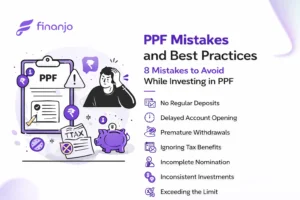
Quick Overview – Common PPF Mistakes and Best Practices
| Mistake | Example | Best Practice |
|---|---|---|
| Depositing after 5th of the month | Deposit on 6th April → No interest for April | Deposit before 5th April |
| Monthly deposits instead of annual | ₹12,500/month → Partial year interest | ₹1.5 lakh lump sum in April |
| Not depositing ₹500 minimum | Account inactive if skipped for a year | Deposit at least ₹500 before March |
| No clear financial goal | Withdraws early, misses compounding | Use for retirement or children’s education |
| Opening multiple accounts | Post Office + SBI → One closed | Only one PPF per person; use family accounts |
| Withdrawing at 15 years without extension | ₹20 lakh maturity → stops compounding | Extend in 5-year blocks for extra growth |
| Not updating nominee | No nominee → Complicated settlement | Review/update nominee regularly |
| Treating PPF as short-term | Needs money in 5 years → locked | Use PPF only for long-term goals |
PPF Mistakes and Best Practices to maximize returns
1. Missing the 5th of the Month Rule
Mistake: Depositing money after the 5th of the month.
- PPF interest is calculated on the lowest balance between the 5th and the last day of the month.
- If you deposit after the 5th, your money won’t earn interest for that month.
Example:
- Deposit ₹1,00,000 on 6th April → Interest starts from May.
- Deposit the same amount on 4th April → Interest counts from April itself.
Best Practice: Always deposit before the 5th of the month to maximize returns.
2. Depositing Monthly Instead of Annually
Mistake: Spreading deposits monthly instead of making a lump sum deposit at the start of the financial year.
- Annual deposits on 1st April maximize compounding.
Example:
- Deposit ₹1.5 lakh on 1st April → Full amount earns interest for 12 months.
- Deposit ₹12,500 every month → Each installment earns interest only for part of the year.
Best Practice: If possible, deposit your full yearly contribution in April itself.
3. Not Depositing the Minimum Amount
Mistake: Forgetting to deposit the minimum ₹500 per year.
- This makes the account inactive.
- To revive, you must pay ₹500 for each missed year + ₹50 penalty per year.
Example:
- If you miss deposits for 2 years → Revival cost = ₹1,000 (deposit) + ₹100 (penalty) = ₹1,100.
Best Practice: Always deposit at least ₹500 before March every year.
4. Investing Without a Goal
Mistake: Opening a PPF account without linking it to a long-term financial goal.
- Many people withdraw early or lose patience because they don’t have clarity.
Example:
- A 25-year-old contributing ₹1.5 lakh annually can build ~₹65–70 lakh tax-free by age 40 (with extensions).
- Without a goal, they may withdraw prematurely and lose compounding benefits.
Best Practice: Use PPF for retirement, children’s education, or long-term wealth – not for short-term needs.
5. Assuming You Can Hold Multiple PPF Accounts
Mistake: Trying to open multiple PPF accounts.
- Legally, one person can hold only one PPF account.
- Duplicate accounts may be closed without interest.
Example:
- If you open one in SBI and another in Post Office → The second will be closed, and only your deposits refunded.
Best Practice: Stick to one PPF account. If you want more exposure, open accounts for family members (children/spouse).
6. Ignoring Extensions After 15 Years
Mistake: Withdrawing everything at maturity without considering extension.
- You can extend PPF in 5-year blocks with or without contribution.
- Extended years also earn tax-free interest.
Example:
- Account matures in 2030 with ₹20 lakh. If you extend for 5 years, it may grow to ₹28–30 lakh without fresh deposits.
Best Practice: Always review whether you need the money or should extend for extra tax-free growth.
7. Not Updating Nominee Details
Mistake: Not nominating or updating nominees in case of marriage, children, or family changes.
- In case of death, settlement becomes complicated.
Best Practice: Review and update nominee details regularly.
8. Expecting Short-Term Liquidity
Mistake: Treating PPF as a short-term investment.
- PPF has a 15-year lock-in with partial withdrawals only after 7 years.
- If you need money earlier, it’s not suitable.
Best Practice: Keep PPF strictly for long-term savings, and use FDs/recurring deposits for short-term needs.
FAQs on Common PPF Mistakes
Q1. What happens if I deposit after the 5th of the month?
Interest will not be calculated for that month.
Q2. Can I revive an inactive PPF account?
Yes, by paying ₹500 per missed year + ₹50 penalty per year.
Q3. Is lump sum better than monthly PPF deposits?
Yes, lump sum deposits (ideally in April) maximize interest.
Q4. Can I withdraw from PPF before 15 years?
Partial withdrawal allowed from 7th year, premature closure only under special cases after 5 years.
Q5. Should I extend my PPF after 15 years?
Yes, if you don’t need funds immediately – extension gives extra tax-free growth.
The PPF is a powerful wealth-building tool when used correctly. Avoiding small mistakes like late deposits, irregular contributions, or premature withdrawals can make a big difference.
- Deposit early (before 5th April).
- Always invest with a long-term goal.
- Extend after 15 years if possible.
- Keep your account active with minimum deposits.
With discipline, PPF can become a cornerstone of your tax-free retirement corpus.
Q6. What if I deposit more than ₹1.5 lakh in a year?
Any amount above ₹1.5 lakh won’t earn interest and won’t get tax benefits—so it’s basically wasted effort.
Q7. What happens if I skip deposits for many years?
Your account becomes inactive, interest slows down, and you’ll have to pay penalties to revive it later.
Q8. Can I have more than one PPF account?
No. Having multiple PPF accounts is illegal and extra accounts will be closed without interest.
Q9. Is it okay to withdraw early for small expenses?
Technically yes (after 7 years), but frequent withdrawals kill the compounding benefit—PPF works best when untouched.
Q10. What if I forget to extend my PPF after 15 years?
The account continues but without fresh deposits, which means you miss out on additional tax-free growth.
Leave a Reply