In India’s fast-evolving digital finance ecosystem, new frameworks and terms have emerged that are reshaping how financial information is shared and used. One of the most important concepts within the Account Aggregator (AA) framework is the idea of a Financial Information Provider, commonly referred to as FIP. Understanding what FIPs are, how they function, and why they matter is essential for borrowers, lenders, and businesses that want to benefit from this system.
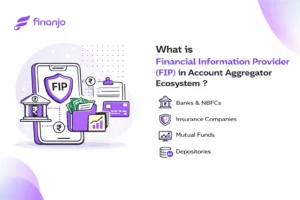
What is Financial Information Provider (FIP)
A Financial Information Provider (FIP) is any regulated financial institution that holds a customer’s financial data and is authorized to share it with consent. In simple terms, FIPs are the source of data in the AA ecosystem. When a customer allows their data to be shared through an AA, the request is fulfilled by the FIP, which provides the verified information to the requesting institution.
Examples of FIPs include:
- Banks that hold savings or current account details
- NBFCs with loan account information
- Insurance companies with policy records
- Mutual fund houses with investment details
- Depositories with securities and holdings data
Role of FIPs in the AA Framework
The AA system connects three key entities: the borrower or customer, the Financial Information Provider (FIP), and the Financial Information User (FIU). The customer sits at the center, giving consent for data sharing. The FIP provides the verified data, while the FIU uses that data for decision-making, such as loan approvals or credit scoring. Without FIPs, the AA framework would not have the authentic data it needs to deliver value.
The role of FIPs can be summarized as:
- Data custodians: They store financial data like transactions, loans, and investments.
- Secure transmitters: They provide the requested data in an encrypted, tamper-proof format via the AA system.
- Trust anchors: Since FIPs are regulated entities, their verified data builds trust for lenders and other financial users.
FIPs in India
India already has a large and rapidly growing list of FIPs integrated with the AA ecosystem. As of 12 September 2025, there are 90 FIPs live in India, covering banks, NBFCs, insurers, and investment institutions. This allows customers to share their data securely across a wide network of trusted financial providers. For example:
- Banks: SBI, HDFC, ICICI, Axis, Kotak Mahindra, along with many others.
- NBFCs: Bajaj Finance, HDB Financial Services, Tata Capital, Shriram Finance, Mahindra & Mahindra Financial Services, along with many others.
- Insurance: Niva Bupa Health Insurance, HDFC Life Insurance, ICICI Prudential Life Insurance, SBI Life Insurance, Bajaj Allianz General Insurance, along with many others.
- Mutual Funds: AMCs like HDFC AMC, ICICI Prudential AMC, SBI Mutual Fund, Nippon India Mutual Fund, Axis Mutual Fund. connected through CAMS and KFintech.
The list continues to grow, and more sectors such as pensions, tax systems, and cooperative banks are expected to be added soon. For the most up-to-date list of all live FIPs, you can check Sahamati’s official registry.
Why FIPs Matter ?
FIPs play a crucial role in ensuring that data shared through the AA framework is authentic, secure, and consent-driven. This matters because traditional methods of sharing data often relied on photocopies or PDFs, which could be tampered with or misplaced. By contrast, FIPs provide verified data directly from the source. This improves decision-making for lenders, reduces fraud, and makes the process faster for customers.
For small businesses, FIPs like banks and GST systems mean they can easily share transaction history and compliance data without paperwork. For individuals, FIPs like banks and mutual funds allow smooth sharing of financial records when applying for loans or investment-linked services.
Challenges for FIPs
Despite their importance, FIPs also face challenges in the AA ecosystem. Many institutions have already onboarded, but a significant number are still in the pipeline. Adoption is therefore a key area to watch, as full benefits of the framework will only be realized when a broader set of FIPs become active.
Some of the main hurdles include:
- Integrating legacy systems with modern APIs
- Ensuring consistent coverage across all branches and customer segments
- Maintaining compliance with strict data security and privacy regulations
- Building customer trust and awareness of consent-based data sharing
These gaps are gradually being addressed through regulatory oversight, technology upgrades, and industry-wide awareness campaigns. Still, the journey toward complete adoption remains ongoing, and scaling participation across all potential FIPs will be crucial for the AA ecosystem to reach its full potential.
Future of FIPs
The scope of FIPs is set to expand significantly in the coming years. While today most FIPs are banks and financial institutions, the framework is being designed to eventually include a wide range of entities, from insurers to pension funds and beyond. As the ecosystem matures, FIPs will be the backbone of a consent-driven data economy, powering not just loans and credit but also wealth management, insurance, and financial planning services.
The ultimate goal is to create a system where customers can move their financial data seamlessly, just as easily as payments move through UPI today. FIPs are central to making this vision possible.
FAQs on FIPs
-
What does FIP stand for?
FIP stands for Financial Information Provider, the entity that holds customer financial data in the AA framework.
-
Who can be an FIP?
Banks, NBFCs, insurance companies, mutual fund houses, and other regulated entities that store customer financial data can be FIPs.
-
How do FIPs interact with AAs?
When a customer consents to share data, the FIP transmits verified, encrypted information to the requesting institution via the AA.
-
Are FIPs regulated?
Yes. Financial institutions which are regulated by bodies like RBI, SEBI, IRDAI, and PFRDA can become FIPs.
-
What is the difference between an FIP and an FIU?
An FIP provides data, while an FIU uses that data for decision-making such as loan approvals.
-
Why are FIPs important for borrowers?
They ensure that borrowers’ financial data is shared securely and accurately, reducing paperwork and speeding up approvals.
-
Can customers choose which data to share from an FIP?
Yes. Sharing is always consent-driven, and customers can control what data is shared, for how long, and with whom.
-
Will more institutions become FIPs in the future?
Yes. The list of FIPs is expected to grow as more financial sectors integrate with the AA ecosystem.
FIPs are the backbone of the Account Aggregator ecosystem. By providing verified and consent-driven data directly from trusted sources, they replace outdated and error-prone methods of information sharing. This ensures that customers’ financial details are transmitted securely, allowing lenders and service providers to make decisions with greater accuracy and speed.
As more banks, NBFCs, insurers, and investment platforms join as FIPs, the ecosystem will become stronger and more inclusive. Their role in supplying authentic data will not only reduce fraud but also enable wider access to credit, insurance, and wealth management, paving the way for a truly consent-driven digital financial system in India.
Leave a Reply