In India’s fast-evolving digital finance ecosystem, new frameworks and terms have emerged that are reshaping how financial information is accessed and used. One of the most important concepts within the Account Aggregator (AA) framework is the idea of a Financial Information User, commonly referred to as FIU. Understanding what FIUs are, how they function, and why they matter is essential for borrowers, lenders, and businesses that want to benefit from this system.
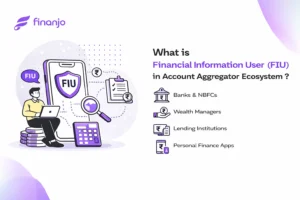
What is Financial Information User (FIU) ?
A Financial Information User (FIU) is any regulated institution that receives financial data from an Account Aggregator after a customer gives consent. In simple terms, FIUs are the end-users of data in the AA ecosystem. When a customer approves sharing of their financial records, the FIU accesses this verified information from the FIP through the AA and uses it to make decisions on loans, insurance, investments, or other financial services.
Examples of FIUs include:
- Banks & NBFCs evaluating loan applications using verified account statements
- Insurance companies reviewing customer details before issuing a policy
- Wealth managers recommending investments based on financial profiles
- Fintech platforms creating new products like BNPL, PFM and many more, using consented data
Role of FIUs in the AA Framework
The AA system connects three key entities: the customer, the Financial Information Provider (FIP), and the Financial Information User (FIU). The customer remains in control, deciding when and how their data is shared. The FIP supplies the verified financial information, while the FIU consumes that data to make decisions such as approving loans, designing insurance products, or offering investment advice. Without FIUs, the AA framework would have no practical impact, since they are the ones who convert data into real financial outcomes.
The role of FIUs can be summarized as:
- Data consumers: They analyze verified information for credit, insurance, and investment purposes.
- Inclusion drivers: FIUs can serve customers who were previously excluded due to lack of formal documentation, improving financial inclusion.
- Innovation catalysts: Fintechs and wealth managers acting as FIUs can design new products such as BNPL, microloans, PFM, or tailored investment plans based on real-time data.
- Decision accelerators: Automated use of structured data allows FIUs to speed up processes like loan approvals and policy issuance.
FIUs in India
India already has a steadily expanding list of FIUs integrated with the AA ecosystem. As of 12 September 2025, hundreds of financial institutions are acting as FIUs, including banks, NBFCs, insurers, and fintech platforms. This enables them to receive verified customer data securely and use it to provide faster, more reliable services. For example:
- Banks: SBI, HDFC Bank, ICICI Bank, Axis Bank, Kotak Mahindra Bank.
- NBFCs: Bajaj Finance, Tata Capital, Shriram Finance, Mahindra & Mahindra Financial Services, Avanse Financial Services, Capri Global Capital.
- Insurance: HDFC Life Insurance, ICICI Prudential Life Insurance, SBI Life Insurance, Bajaj Allianz General Insurance, Max Life Insurance.
- Fintech/Wealth: 5Paisa, Angel One, Bajaj Finserv Direct (Bajaj Markets), Jupiter (Amica Investment Advisers), Circle Wealth Advisors.
The number of FIUs continues to rise, and adoption is seen as a critical factor for the AA framework’s success. As more institutions join, the benefits will extend beyond lending into areas like wealth management, retirement planning, and digital insurance. For the most up-to-date list of FIUs live on the network, you can check Sahamati’s official registry.
Why FIUs Matter
FIUs are the reason the Account Aggregator framework delivers real value. They turn verified and consent-driven financial data into actionable outcomes such as faster loans, tailored insurance, or investment opportunities. This is critical because traditional financial decisions often relied on incomplete, self-reported, or paper-based information that could slow down approvals or lead to errors. With FIUs consuming structured data directly from trusted sources, the process becomes faster, more reliable, and more transparent.
For small businesses, FIUs such as banks and NBFCs can evaluate creditworthiness quickly using verified transaction history, enabling easier access to working capital. For individuals, FIUs such as lenders, insurers, and wealth managers can use shared data to offer quicker approvals, better terms, and more personalized financial products, making the entire experience smoother and more inclusive.
Challenges for FIUs
Despite their importance, FIUs also face challenges in the AA ecosystem. Many large institutions have already joined, but a significant number are still in the process of onboarding. Adoption is therefore a critical area to watch, since the full benefits of the framework will only emerge when a wider set of FIUs are actively using it.
Some of the main hurdles include:
- Integrating legacy systems with modern APIs and digital workflows
- Redesigning existing credit and risk assessment processes to work with AA data
- Ensuring compliance with strict data security and regulatory standards
- Educating customers about how consent-driven sharing works and why it is safe
These challenges are gradually being addressed through regulatory guidance, technology upgrades, and industry-wide awareness efforts. Still, scaling participation across the financial sector remains essential for the AA ecosystem to achieve its full potential.
Future of FIUs
The scope of Financial Information Users is expected to grow rapidly in the coming years. While today most FIUs are banks, NBFCs, and a handful of fintech platforms, the framework is being designed to eventually include a wider variety of institutions, from insurers and wealth managers to pension funds and even new-age digital platforms. As adoption increases, FIUs will become central to turning verified financial data into products that cover not just credit but also wealth management, digital insurance, retirement planning, and personalized investment solutions.
The ultimate goal is to create a seamless environment where customers can share their data as easily as they make payments on UPI today. FIUs will be the ones translating this flow of information into tangible benefits like faster access to credit, fairer risk assessment, and more innovative financial products. As the ecosystem matures, FIUs will play a pivotal role in ensuring that India’s consent-driven data economy delivers value for both individuals and businesses.
In India’s fast-evolving digital finance ecosystem, new frameworks and terms have emerged that are reshaping how financial information is accessed and used. One of the most important concepts within the Account Aggregator (AA) framework is the idea of a Financial Information User, commonly referred to as FIU. Understanding what FIUs are, how they function, and why they matter is essential for borrowers, lenders, and businesses that want to benefit from this system.
FAQs on FIUs
-
What does FIU stand for?
FIU stands for Financial Information User, which is a regulated entity that consumes financial data from an FIP with customer consent.
-
Who can be an FIU?
Banks, NBFCs, insurers, wealth managers, and fintech companies can all act as FIUs in the AA ecosystem.
-
How do FIUs use customer data?
FIUs use verified data to evaluate creditworthiness, process loan applications, design insurance products, and offer investment advice.
-
Are FIUs regulated?
Yes. FIUs are regulated entities under RBI, SEBI, IRDAI, or PFRDA, depending on their sector.
-
What is the difference between an FIP and an FIU?
An FIP provides data, while an FIU uses that data for decision-making and product offerings.
-
Why are FIUs important for borrowers?
They ensure that borrowers’ financial data is used effectively to provide faster approvals, better loan terms, and wider access to financial products.
-
Do FIUs store customer data permanently?
No. FIUs receive encrypted data through the AA system, and its use is limited to the consent parameters set by the customer.
-
Will the number of FIUs increase in the future?
Yes. As adoption grows, more financial institutions across sectors are expected to integrate as FIUs.
FIUs are central to making the Account Aggregator ecosystem truly valuable. By consuming verified and consent-driven data, they help transform financial decisions into faster, safer, and more transparent outcomes. From quicker loan approvals to tailored insurance and investment products, FIUs ensure that customers benefit directly from the AA framework.
As adoption grows across banks, NBFCs, insurers, and fintech platforms, FIUs will drive financial inclusion and innovation at scale. Their ability to use structured data responsibly will not only improve trust but also expand access to credit and financial services for millions of individuals and small businesses in India.
This is very useful