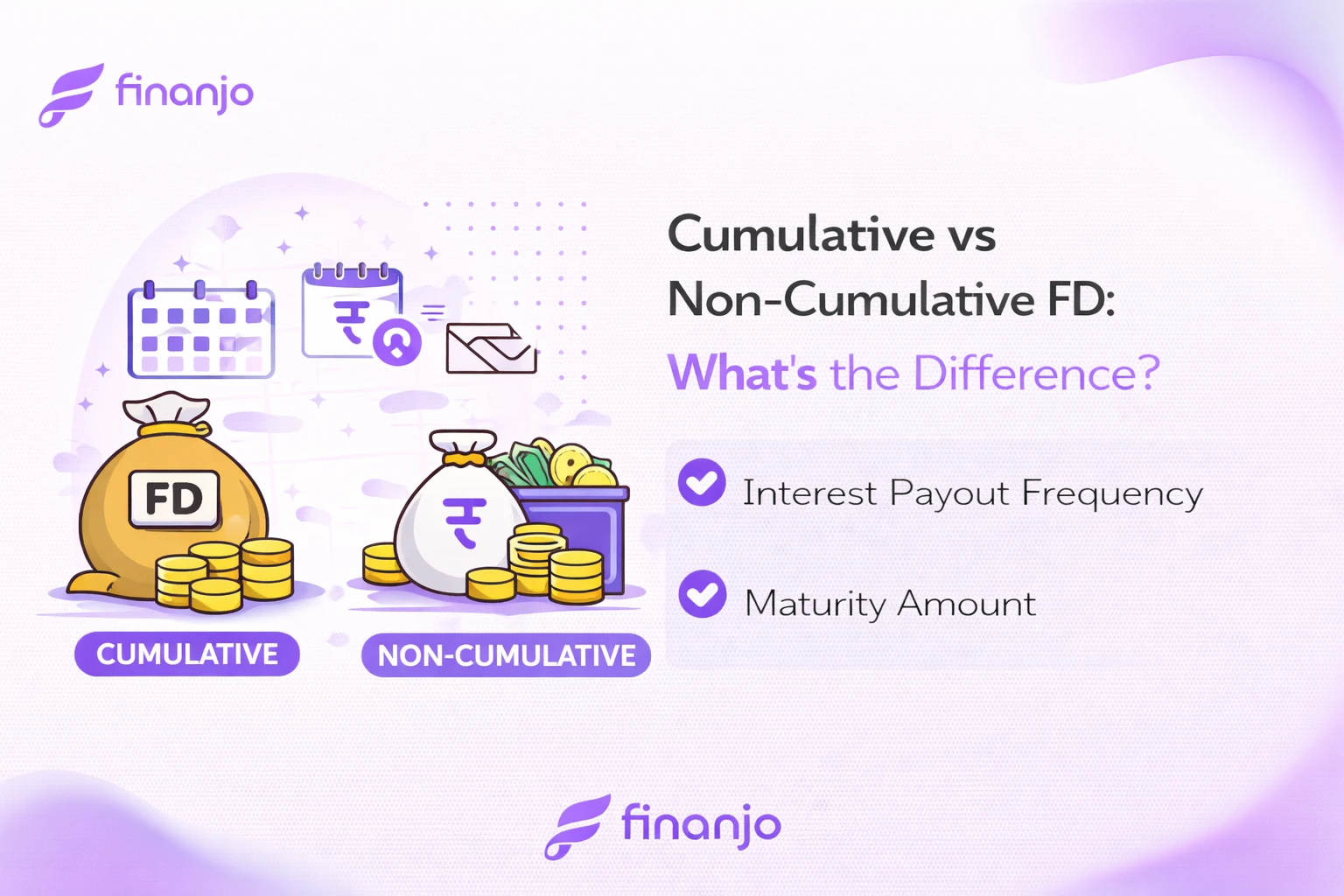
A Fixed Deposit is categorized into a Cumulative vs Non-Cumulative FD depending on the interest payout frequency. Cumulative vs Non-Cumulative FD is a common comparison for investors who want to choose the right fixed deposit payout option based on their income and investment goals. In a cumulative FD, interest is reinvested and paid along with the principal at maturity, helping your money grow faster. In contrast, a non-cumulative FD pays interest at regular intervals such as monthly, quarterly, or annually, making it suitable for those who need a steady income. Understanding the difference between cumulative and non-cumulative FD options will help you decide which one aligns better with your financial needs and cash flow requirements.
This blog shares with you the differences between cumulative vs non-cumulative fixed deposits in detail, helping you decide which one is right for you.
Understanding Fixed Deposit Types
Fixed deposits remain a cornerstone of Indian investment portfolios, with 45% of urban households considering them essential for financial security. When investing in an FD, the first decision you’ll face is choosing between cumulative and non-cumulative options. The cumulative vs non-cumulative fixed deposit choice significantly impacts how your money grows and how you receive returns. While both provide guaranteed returns, they cater to different financial needs and goals.
Let’s break down these differences to help you make an informed decision for your hard-earned money.
What is Cumulative FD?
A cumulative FD is one in which the interest is compounded and paid with the deposit at the time of the maturity. It is an ideal investment option for people looking to build a corpus as opposed, as opposed to earning regular interest payments. Since the interest accrued on the cumulative Fixed Deposit is reinvested, you get the benefit of compounded returns, which in turn leads to the creation of a lump sum amount at the end of the FD tenure.
Let us understand the concept better with an example:-
If a Anushka Sharma starts a fixed deposit of ₹1,00,000 for a tenure of 5 years with the interest of 7% p.a. the interest earned is shown below:
| Year | Deposit | Interest earned | Total amount |
|---|---|---|---|
| 1 | ₹1,00,000 | ₹7,000 | ₹1,07,000 |
| 2 | ₹1,07,000 | ₹7,490 | ₹1,14,490 |
| 3 | ₹1,14,490 | ₹8,014 | ₹1,22,504 |
| 4 | ₹1,22,504 | ₹8,575 | ₹1,31,079 |
| 5 | ₹1,31,079 | ₹9,175 | ₹1,40,254 |
Cumulative FD Calculation:
- Initial investment: ₹1,00,000
- Tenure: 5 years
- Interest rate: 7% p.a. compounded quarterly
- Maturity amount: ₹1,40,710
- Total interest earned: ₹40,710
Who Should Invest in Cumulative Fixed Deposits?
This type of fixed deposit scheme is suitable for those who do not depend on income through interest. Generally, people with a stable job and income and people who are earning well through their business invest in this.
So, if you want a particular amount in the future, and can easily manage without a particular interest regularly, you can consider cumulative FD.
Benefits of Cumulative FDs:
- Higher returns on maturity: The compounding effect leads to increased returns on the Cumulative FD, making it an attractive option for long-term investors.
- Ideal for long-term goals: Cumulative FDs are well suited for individuals with long-term financial objectives such as retirement planning or buying a house.
- Convenient and hassle-free: Investors do not have to worry about periodic interest payouts as the interest is reinvested in the FD until maturity
Who Should Choose Cumulative FDs?
Cumulative fixed deposits are ideal for:
- Long-term investors focused on wealth creation
- Individuals with no immediate need for regular income
- Parents saving for their children’s education or marriage
- Working professionals building a retirement corpus
- Those in higher tax brackets who prefer deferring tax liability
For example –
Sabari, a 32-year-old IT professional, invested ₹5 lakh in a cumulative FD for his daughter’s education. With no immediate need for the interest income, She chose compounding to maximise returns. After 7 years, her investment grew to ₹8.2 lakh, providing a substantial education fund.
What is Non-Cumulative Fixed Deposit ?
A non-cumulative fixed deposit pays the accumulated interest regularly to the investor. Based on the choice of the investor, interest can be monthly, quarterly, half-yearly or yearly. It is essential to know that the interest rates vary for each payout option. For instance, the interest rates for monthly, quarterly, half-yearly and yearly payouts can be 6.5%, 6.75%, 7% and 7.05%, respectively. Furthermore, the interest earned is taxable in the hands of investors at the time of receipt.
The tenure ranges from 6 months to 5 years. A non-cumulative is preferred by investors who require a regular income, for example, pensioners.
Let us understand a non-cumulative fixed deposit with the help of an example.
If a Rohit Sharma starts a fixed deposit with ₹1,00,000 for a tenure of 5 years at the interest of 7% p.a., assuming that the interest payout is every year. His interest earned is shown below.
| Year | Deposit | Interest earned | Total amount |
|---|---|---|---|
| 1 | ₹1,00,000 | ₹7,000 | ₹1,07,000 |
| 2 | ₹1,07,000 | ₹7,490 | ₹1,14,490 |
| 3 | ₹1,14,490 | ₹8,014 | ₹1,22,504 |
| 4 | ₹1,22,504 | ₹8,575 | ₹1,31,079 |
| 5 | ₹1,31,079 | ₹9,175 | ₹1,40,254 |
Non-Cumulative FD Calculation (annual payout):
- Initial investment: ₹1,00,000
- Annual interest payout: ₹7,000
- Total interest over 5 years: ₹35,000
- Maturity amount: ₹1,00,000 (original principal)
Who should invest in non-cumulative FD?
Non-cumulative FD works best for retirees, freelancers and housewives who seek regular income from their savings.
Benefits of Non-cumulative FDs:
- Steady income stream: Non-cumulative FDs provide a regular and predictable income stream to investors, making them suitable for individuals who rely on the fixed interest earnings to meet their financial needs.
- Flexibility in payout options: Investors can choose the frequency of interest payout based on their cash flow requirements, providing flexibility in managing the finances.
Who Should Choose Non-Cumulative FDs?
A non-cumulative fixed deposit will be a good choice for those who want a regular income, especially retired people and senior citizens. In other words, if you want a consistent income from your savings, this is the right choice.
Non-cumulative fixed deposits work best for:
- Retirees needing regular income
- Individuals with monthly financial commitments
- Self-employed professionals managing cash flow gaps
- Senior citizens supplementing their pension income
- Investors in lower tax brackets who can manage annual tax payments
For example-
Sheela Joseph, a 65-year-old retiree, invested ₹10 lakh in a non-cumulative FD with monthly interest payouts. This provided her ₹6,250 monthly (at 7.5% p.a.), helping cover regular expenses while preserving her principal amount.
Key Differences Between Cumulative vs Non-Cumulative FD
The difference between cumulative and non-cumulative FD primarily revolves around how interest payments are handled:
| Particulars | Cumulative Fixed Deposit | Non-cumulative Fixed Deposit |
| Definition | An FD where interest is earned and re-invested regularly but paid out with the FD amount at the end of the FD tenure | An FD where interest is paid at regular intervals and the FD amount is paid out at the end of the FD tenure |
| Interest Payout | Only at maturity | Monthly / quarterly / half-yearly / annually, as chosen |
| Reinvestment of Interest | Interest is reinvested to earn more | No reinvestment, interest is paid out |
| Returns | Higher returns due to compounding | Lower returns than cumulative FDs |
| Suitable For | Salaried individuals and long-term investors | Retirees, homemakers and individuals who want a regular income |
| Income Flow | No income during the deposit period | Regular flow of income throughout the FD tenure |
Here are the key things to consider before you make a choice:
1. Financial Goals: Define your financial objectives clearly. A Cumulative FD might be more suitable if you are looking for long-term wealth accumulation and can forego periodic interest payouts. On the other hand, if you require regular income for monthly expenses or specific financial goals, a Non-cumulative FD would be a better choice.
2. Liquidity Needs: Assess your liquidity needs and emergency fund requirements. A Cumulative FD locks your funds until maturity while a Non-cumulative FD allows you to receive regular interest payouts. If you anticipate the need for funds in the short term, a Non-cumulative FD provides more flexibility in accessing the interest earnings.
3. Tax implications: Evaluate the tax implications of both the options. In a Cumulative FD, the interest is reinvested and added to the principal amount, leading to a higher tax liability upon maturity. On the other hand, in a Non-cumulative FD, the interest is paid regularly and you have to pay tax on the interest income as per your tax slab each year.
4. Penalty for premature withdrawal: Check the penalty or loss of interest applicable for premature withdrawal or closure. In some cases, choosing a shorter tenure for a Non-cumulative FD might be more beneficial instead of breaking a long-term Cumulative FD.
By carefully considering these factors and conducting a comprehensive analysis, you can make an informed decision between Cumulative and Non-cumulative FDs to maximise your returns and achieve your financial objectives.
How to Maximise FD Returns?
FD returns can be maximised in the cumulative option. Here, the interest accumulated is reinvested on a regular basis. Thus, the interest accrued in the first cycle (generally yearly or quarterly) is added to the principal. This leads to an increased principal. Interest in the second cycle is calculated on this increased principal that leads to higher interest. This goes on until the FD tenure is not over.
This way, interest at the end of the FD tenure becomes higher than a traditional non-cumulative fixed deposit and returns are swelled to the maximum.
Cumulative vs Non-Cumulative FD: Which is better for me?
The choice between the two modes of interest payment depends on your preference. If your purpose is to add-on to your existing income or to provide for pension after retirement, non-cumulative FD is your pick.
The choice between these two types of interest payouts can be an investor’s decision depending on their requirement and needs. If your investment purpose is to add something to your existing income or get a pension after retirement, then it is best to choose a non-cumulative fixed deposit. However, suppose your investment purpose is not to look for any add-on but to multiply your existing savings at a good exponential rate, you can opt for a cumulative fixed deposit without any second thought.
How Interest Works in both FDs ?
In a cumulative FD, interest earned is reinvested, allowing your money to grow through the power of compounding. With fixed deposit investments, this compounding effect can significantly boost your returns over time.
Non-cumulative FDs, meanwhile, pay out interest at regular intervals as per your chosen frequency. This provides a steady income stream but sacrifices the compounding advantage.
Pro Tip: If you don’t need regular income, cumulative FDs typically offer 0.5-1% higher effective returns compared to non-cumulative options due to the compounding effect.
Tax Implications: An Important Consideration
When evaluating cumulative vs non-cumulative fixed deposit options, tax implications deserve careful attention:
- Cumulative FDs: TDS is deducted annually but paid at maturity. The entire interest amount is taxable in the year of maturity, potentially pushing you into a higher tax bracket.
- Non-Cumulative FDs: Interest is taxed in the year it’s received, spreading the tax liability across multiple years.
If you plan to invest substantial amounts, consider submitting Form 15G/15H to avoid TDS if your income is below the taxable limit. You’ll need to provide proper documents for this purpose.
What is Form 15G?
- Resident individuals aged below 60 years can file Form 15G to prevent the deduction of TDS.
- It can also be filed by HUFs, trusts, or any other person (except a firm or company).
- It can be filed only if the estimated income of resident individuals for the relevant financial year is less than the basic exemption limit.
- Form 15G has to be submitted quarterly to the person or entity responsible for deducting TDS, either electronically or in physical paper form.
What is Form 15H?
- Form 15H can be filed by resident senior citizens aged 60 years or above.
- It can be filed only if the senior citizen’s total income for the relevant financial year results in nil tax liability.
- Form 15H must be submitted quarterly to the person or entity responsible for deducting TDS, either electronically or in physical form.
Form 15G and Form 15H PDF Download
Liquidity Considerations
Both FD types allow premature withdrawals, but with different implications:
- Breaking a cumulative FD means losing the compounding advantage
- With non-cumulative FDs, you’ve already received some interest, minimising the impact
For emergency needs, consider a loan against your FD instead of a premature withdrawal. This option typically offers loans up to 90% of your deposit value at interest rates 1-2% higher than your FD rate.
Making the Right Choice
When deciding between cumulative and non-cumulative FDs, ask yourself:
- Do I need regular income from my investment?
- Am I investing for a specific future goal?
- What is my current tax bracket?
- How important is maximising returns versus maintaining liquidity?
Today’s competitive interest rates make fixed deposits an attractive option for both income generation and wealth creation. Choose the type that aligns with your financial priorities.
How to Choose Between the Two
Salaried individuals, or small business owners, who don’t necessarily need any added income to meet their monthly expenses can easily opt for a cumulative FD. By saving a larger amount, the corpus built using a cumulative scheme can also help meet long-term financial goals.
For retired individuals and pensioners, who don’t have a steady source of income, non-cumulative FDs are a better bet. They provide periodic payments on a regular basis, allowing such individuals to better plan their day-to-day and monthly expenses.
Irrespective of which section of society you belong to, an FD, can help you build a better corpus for the future. In fact, they are the most preferred form of investment to help individuals meet their long-term financial goals.
An Example:
Suppose, Virat Kohli deposit Rs. 1,00,000 in a fixed deposit for a tenure of 5 years with an 8.5% rate of interest and Virat Kohli selected monthly compounding frequency in the cumulative FD. In such a situation, Virat Kohli will get Rs. 1,52,730 upon maturity.
However, if Virat Kohli select quarterly compounding for Rs. 1,00,00 and with the same rate of interest, Virat Kohli will get Rs. 1,52,279 upon maturity.
If Virat Kohli select half-yearly compounding for this principal amount and the same rate of interest, Virat Kohli will get Rs. 1,51, 621 upon maturity.
If Virat Kohli select yearly compounding frequency on the same principal amount and with the same rate of interest, then the amount that Virat Kohli will get at maturity would be Rs. 1,50,365.
However, if Virat Kohli opt for non-cumulative FD for a tenure of 5 years and on yearly basis at the rate of interest of 9.25%, Virat Kohli will get Rs. 1,46,250 upon maturity. The interest earned is Rs. 46,250.
On a half-yearly, quarterly, and monthly basis for the same principal amount with the same rate of interest and same tenure, the maturity amount will be Rs. 1,45,250, Rs. 1,44,750, and Rs. 1,44,500 respectively.
FAQs about Cumulative and Non-cumulative Fixed Deposit
1. What is the main difference between cumulative and non-cumulative fixed deposits?
Cumulative FDs reinvest interest, paying everything at maturity, while non-cumulative FDs distribute interest periodically (monthly/quarterly/annually) throughout the tenure.
2. Which type of FD gives higher returns?
Cumulative FDs typically yield higher returns due to compounding, where interest earns interest. This creates a notable difference between cumulative and non-cumulative FD returns over longer periods.
3. Are cumulative FDs better for tax planning?
Not necessarily. Cumulative FDs concentrate tax liability at maturity, while non-cumulative FDs spread tax across multiple years, which can be advantageous for tax planning.
4. Can I change from cumulative to non-cumulative FD after investing?
Most banks don’t allow switching between cumulative vs non-cumulative fixed deposit types after opening. You’ll typically need to close the existing FD and open a new one.
5. How does cumulative FD translate to senior citizens?
For seniors, cumulative FDs can build legacy wealth, while non-cumulative options provide regular income. Many institutions offer 0.25-0.50% higher rates for senior citizens on both types.
Leave a Reply