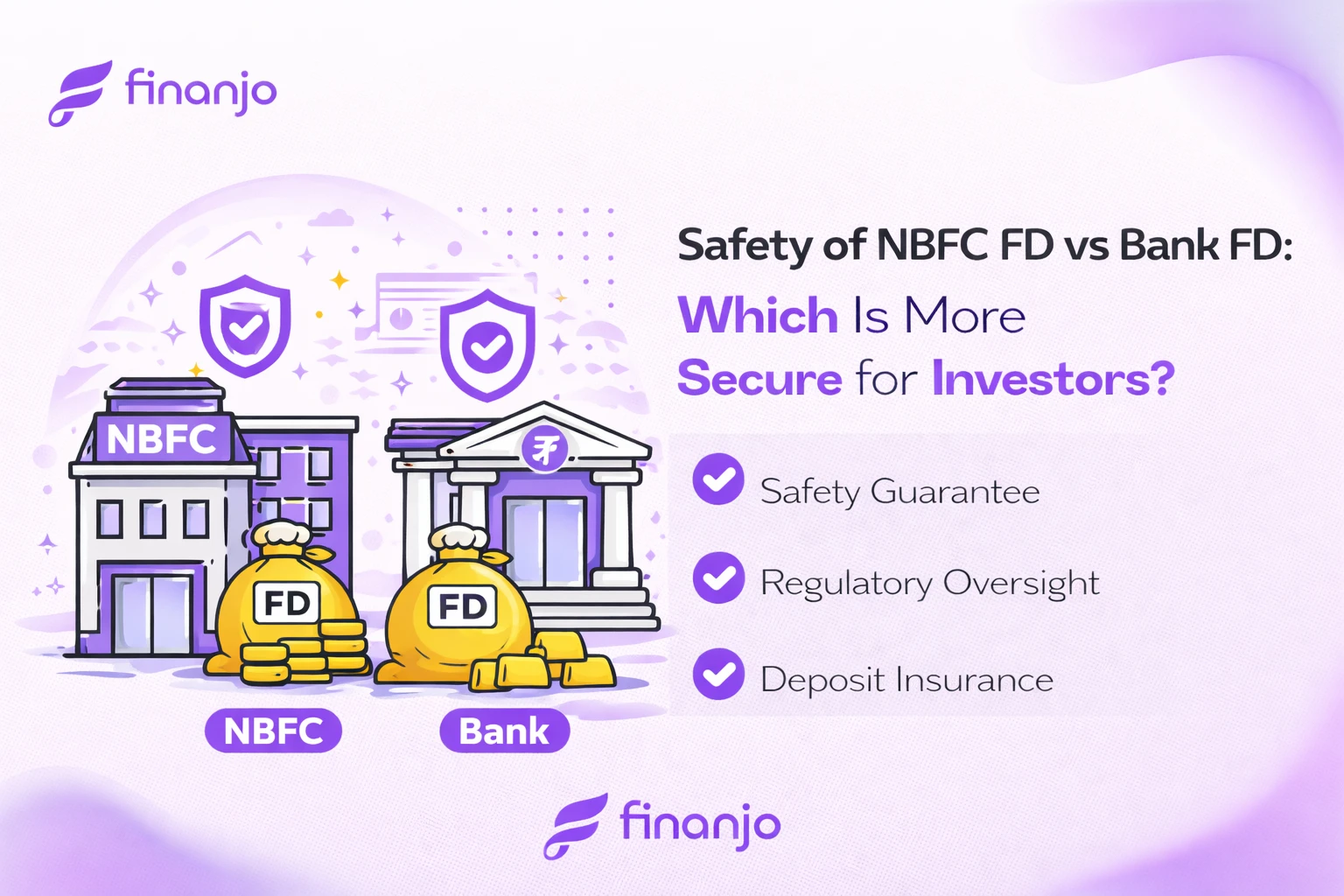
When comparing NBFC FD vs Bank FD, many investors worry about one key question: how safe is their money, especially in uncertain economic conditions. Fixed Deposits are traditionally seen as low-risk investments, but concerns around safety have become more prominent in recent years.
At the same time, NBFC Fixed Deposits have gained popularity because they often offer higher interest rates than bank FDs. For investors seeking better returns without taking market risk, this can be tempting.
This brings us to the key question investors need to answer before investing: Are NBFC FDs as safe as bank FDs, and how should one choose between the two?
What is a Bank FD?
A bank Fixed Deposit (FD) is a savings instrument offered by scheduled banks where you invest a lump-sum amount for a fixed tenure at a pre-decided interest rate. The rate is locked in at the time of investment, which means the returns are known in advance.
How do bank FDs work?
When you open a bank FD, you choose the deposit amount and tenure, which can range from a few days to several years. The bank pays interest at the agreed rate, either periodically (monthly, quarterly, etc.) or at maturity, depending on the type of FD selected. Since the interest rate does not change during the tenure, the maturity value is predictable.
Why are bank FDs considered safe?
Bank FDs are considered safe because they are not linked to market fluctuations and offer assured returns. In addition, deposits with banks are covered under the deposit insurance framework up to the prescribed limit, which provides an extra layer of protection for investors.
Because of this combination of predictability, regulatory oversight, and capital protection, bank FDs are widely trusted by conservative investors, senior citizens, and those seeking stable returns.
What is an NBFC FD?
An NBFC Fixed Deposit is a deposit scheme offered by Non-Banking Financial Companies (NBFCs), where investors place a lump-sum amount for a fixed tenure at a predetermined interest rate. Like bank FDs, the interest rate is fixed at the time of investment, and the returns are known in advance.
How do NBFCs raise deposits?
NBFCs raise funds through multiple sources, including market borrowings, bank loans, bonds, and public fixed deposits. These deposits are used to fund their lending and financing activities across sectors such as housing, infrastructure, and consumer finance.
Unlike banks, NBFCs do not accept savings or current account deposits, and they operate under a different regulatory framework. As a result, their deposit-taking activities are more limited and governed by specific rules set by the regulator.
Why do NBFC FDs usually offer higher interest rates?
NBFC Fixed Deposits generally offer higher interest rates than bank FDs to compensate investors for the relatively higher risk involved. Since NBFCs do not have access to low-cost deposits like savings accounts, they rely more on fixed deposits and borrowings to raise funds.
Higher interest rates help NBFCs attract investors, especially those willing to take slightly higher risk in exchange for better returns. However, this also makes it important for investors to carefully assess the financial strength and credit rating of the NBFC before investing.
Safety of Bank FDs
Bank Fixed Deposits are widely considered one of the safest investment options in India due to strong regulation, deposit insurance coverage, and overall financial stability.
Regulation by the RBI
Banks in India are regulated by the Reserve Bank of India (RBI), which sets strict guidelines on capital adequacy, liquidity, and risk management. This regulatory oversight helps ensure that banks operate in a controlled and transparent manner, reducing the risk of defaults.
Deposit insurance coverage
Bank deposits are covered under the deposit insurance framework up to the prescribed limit per depositor per bank. This coverage applies to both principal and interest and provides an added layer of protection in the unlikely event of a bank failure.
While this does not eliminate all risk, it significantly improves deposit safety compared to unregulated investment options.
Capital protection and stability
Bank FDs offer capital protection, as the principal amount and interest rate are fixed at the time of investment. Returns are not linked to market movements, which makes bank FDs suitable for investors seeking stability and predictable outcomes.
Public sector vs private sector banks
Both public sector and private sector banks offer Fixed Deposits with similar structural safety features. Public sector banks are often perceived as more stable due to government ownership, while private sector banks may offer slightly higher interest rates but are equally regulated by the RBI.
In practice, safety depends more on the bank’s financial health and regulatory compliance than on ownership alone.
Safety of NBFC FDs
NBFC Fixed Deposits can offer higher interest rates than bank FDs, but they come with a different risk profile. Understanding how NBFCs are regulated and how safety is assessed is essential before investing.
Regulation of NBFCs by the RBI
NBFCs in India are regulated by the Reserve Bank of India (RBI), but under a framework that is different from banks. The RBI sets rules related to capital adequacy, liquidity, and exposure limits for NBFCs to ensure financial discipline.
However, NBFCs do not have the same access to low-cost deposits as banks, and their business models are more closely linked to lending and market conditions. This makes regulatory oversight important but not a guarantee of safety.
Credit ratings and what they indicate
The safety of an NBFC FD is closely linked to the credit rating assigned by recognised rating agencies. These ratings reflect the NBFC’s ability to meet its financial obligations on time.
- Higher-rated NBFCs indicate stronger financial health and lower default risk
- Lower-rated NBFCs may offer higher interest rates but carry higher risk
Credit ratings help investors assess risk, but they are not guarantees. Ratings can change based on the NBFC’s financial performance and market conditions.
Absence of deposit insurance
Unlike bank FDs, most NBFC Fixed Deposits are not covered under deposit insurance. This means that in the event of a default, investors do not have the same level of protection available for bank deposits.
This lack of insurance is a key reason why NBFC FDs typically offer higher interest rates than bank FDs.
Importance of choosing highly rated NBFCs
Given the absence of deposit insurance, it is important to invest only in well-established, highly rated NBFCs with a strong track record. Investors should review credit ratings, financial statements, and overall stability before committing funds.
NBFC FDs can be considered for diversification or higher returns, but only after carefully evaluating risk and avoiding over-concentration.
Bank FD vs NBFC FD: Key Safety Differences
Understanding the safety differences between bank FDs and NBFC FDs becomes easier when you compare them across regulation, risk, and investor protection.
| Factor | Bank Fixed Deposit | NBFC Fixed Deposit |
|---|---|---|
| Regulatory oversight | Regulated by the RBI under a comprehensive banking framework with strict norms on capital, liquidity, and risk management | Regulated by the RBI, but under a separate framework with different rules compared to banks |
| Deposit insurance | Covered under the deposit insurance framework up to the prescribed limit per depositor per bank | Generally not covered by deposit insurance |
| Credit risk | Lower credit risk, as banks have diversified operations and stronger regulatory safeguards | Higher credit risk compared to banks; depends heavily on the NBFC’s financial health and credit rating |
| Interest rates | Usually lower, reflecting higher safety and lower risk | Typically higher to compensate investors for additional risk |
| Liquidity and premature withdrawal | Premature withdrawal usually allowed, with a small penalty | Premature withdrawal may be restricted or subject to stricter conditions, depending on the NBFC |
This comparison highlights that while bank FDs prioritise safety and protection, NBFC FDs offer higher returns with higher risk. The choice depends on how much risk an investor is willing to take in exchange for better interest rates.
Risk Factors to Consider Before Investing
Before choosing between a bank FD and an NBFC FD, it is important to evaluate a few key risk factors. These help determine whether the investment aligns with your safety expectations and liquidity needs.
Credit rating of the institution
The credit rating reflects the institution’s ability to meet its financial obligations. Higher-rated banks or NBFCs generally indicate lower default risk, while lower ratings may signal higher risk despite offering higher interest rates. Investors should always check the latest credit rating before investing.
Financial health and track record
An institution’s financial strength and operating history matter. Factors such as profitability, asset quality, and consistency in repayments provide insight into long-term stability. A strong track record often indicates better risk management and reliability.
Interest rate risk
Interest rates in the economy change over time. When rates rise, existing FDs with lower locked-in rates may become less attractive. While this does not affect the safety of the investment, it can impact return competitiveness, especially for longer tenures.
Liquidity needs
FDs are generally less liquid than savings accounts. While premature withdrawal is usually allowed, it may come with penalties or restrictions particularly in NBFC FDs. Investors should assess their cash flow needs and avoid locking in funds they may need in the short term.
Which Is Safer: Bank FD or NBFC FD?
When safety is the primary concern, bank Fixed Deposits are generally considered safer than NBFC Fixed Deposits. Bank FDs benefit from stronger regulatory oversight, deposit insurance coverage up to the prescribed limit, and a long-standing perception of stability. This makes them suitable for investors who prioritise capital protection and low risk.
NBFC Fixed Deposits, on the other hand, often offer higher interest rates, but this comes with higher risk. Most NBFC FDs are not covered by deposit insurance, and their safety depends largely on the NBFC’s credit rating, financial health, and business model. As a result, NBFC FDs are better suited for investors who are willing to accept some additional risk in exchange for higher returns.
The balanced view
There is no universal answer to which option is “better.”
- Bank FDs are more appropriate for conservative investors, senior citizens, and those with low risk tolerance.
- NBFC FDs may suit investors seeking higher returns who are comfortable evaluating credit risk and limiting exposure.
In practice, the choice depends on your risk appetite, return expectations, and investment horizon, rather than interest rates alone.
Who Should Choose Bank FDs and Who Should Choose NBFC FDs?
Choosing between bank FDs and NBFC FDs depends on your risk tolerance, return expectations, and investment horizon. Each option suits a different type of investor.
Who should choose Bank Fixed Deposits?
Bank FDs are better suited for investors who prioritise safety and predictability. They are a good fit for:
- Risk-averse investors who prefer low-risk investments
- Senior citizens seeking stable and dependable income
- Investors with short-term goals or those building an emergency fund
- Individuals who value capital protection over higher returns
Bank FDs work well when certainty and liquidity are more important than maximising interest rates.
Who should choose NBFC Fixed Deposits?
NBFC FDs may be suitable for investors who are comfortable taking slightly higher risk in return for better yields. They are more appropriate for:
- Investors willing to accept higher risk for higher interest rates
- Those actively seeking better returns than traditional bank FDs
- Long-term investors who can assess credit ratings and financial strength
- Investors who can diversify and avoid over-concentration in a single issuer
NBFC FDs are best considered as a supplement to safer investments, rather than a complete replacement for bank FDs.
Can You Invest in Both?
Yes, many investors choose to invest in both bank FDs and NBFC FDs as part of a diversification strategy. Using both can help balance safety and returns, provided the risks are managed carefully.
Diversification as a strategy
Investing across different institutions helps reduce concentration risk. While bank FDs offer higher safety, NBFC FDs can enhance overall returns. Combining the two allows investors to avoid relying entirely on a single type of issuer.
Spreading risk across banks and NBFCs
Instead of placing all funds in one FD, investors can spread deposits across:
- Multiple banks
- Select, highly rated NBFCs
This approach helps limit exposure to any one institution and improves overall portfolio resilience.
Matching investments to financial goals
A practical way to use both is to align them with specific goals:
- Bank FDs for emergency funds, short-term needs, and capital protection
- NBFC FDs for surplus funds where slightly higher risk is acceptable in exchange for better returns
The right mix depends on your goals, time horizon, and comfort with risk not just interest rates.
FAQs on NBFC FD vs Bank FD
1. Are NBFC FDs safe in India?
NBFC Fixed Deposits are regulated by the Reserve Bank of India (RBI), but they are not as safe as bank FDs. Their safety depends largely on the NBFC’s credit rating, financial health, and track record. Well-rated NBFCs are generally considered safer than lower-rated ones, but they still carry higher risk compared to banks.
2. Do NBFC FDs have deposit insurance?
In most cases, NBFC Fixed Deposits do not have deposit insurance. This means investors may not receive the same protection available for bank deposits in the event of a default. This lack of insurance is one of the reasons NBFC FDs typically offer higher interest rates.
3. Which is better: bank FD or NBFC FD?
Neither option is universally better.
- Bank FDs are more suitable for investors who prioritise safety, capital protection, and liquidity.
- NBFC FDs may appeal to investors seeking higher returns and who are comfortable evaluating credit risk.
The right choice depends on your risk tolerance, return expectations, and investment horizon.
4. Are NBFC FDs riskier than bank FDs?
Yes, NBFC FDs are generally riskier than bank FDs. Bank FDs benefit from stronger regulatory safeguards and deposit insurance up to the prescribed limit, while NBFC FDs rely more on the financial stability and creditworthiness of the issuing NBFC.
5. Should senior citizens invest in NBFC FDs?
Senior citizens should approach NBFC FDs with caution. While higher interest rates may seem attractive, the higher risk and lack of deposit insurance make bank FDs a safer choice for most retirees. NBFC FDs may be considered only for surplus funds and preferably in highly rated NBFCs, after careful evaluation.
Leave a Reply