The Public Provident Fund (PPF) is one of the safest investment options in India. It is backed by the Government of India, which means your money is completely secure. Apart from giving steady returns, PPF is also an excellent tax-saving option under Section 80C of the Income Tax Act.
What makes PPF even more attractive is that it falls under the rare Exempt-Exempt-Exempt (EEE) category. This means:
- The money you invest is eligible for tax deduction (Exempt at investment).
- The interest you earn every year is tax-free (Exempt on interest).
- The maturity amount you receive after 15 years is also tax-free (Exempt at withdrawal).
In short, you save tax when you invest, you don’t pay tax while your money grows, and you don’t pay tax when you withdraw. Let’s understand these tax benefits of PPF with simple examples.
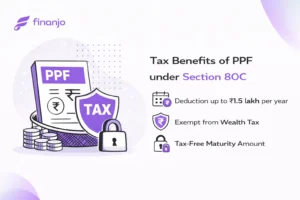
Quick Overview of Tax Benefits of PPF
| Benefit Type | Details |
|---|---|
| Section 80C Deduction | You can claim tax deduction on deposits up to ₹1.5 lakh per year. |
| Interest Earned | The interest credited annually is completely tax-free. |
| Maturity Amount | The full maturity value (your investment + interest) is tax-free. |
| Status | Falls under EEE (Exempt-Exempt-Exempt) category. |
1. Deduction under Section 80C
When you invest in PPF, the amount is eligible for deduction under Section 80C. This helps you reduce your taxable income and pay less tax.
Example:
- Your annual income: ₹8,00,000
- You invest ₹1,50,000 in PPF in FY 2025–26
- Deduction allowed under Section 80C: ₹1,50,000
- New taxable income after deduction: ₹6,50,000
By simply investing in PPF, you bring down your taxable income, which directly reduces your income tax liability.
2. Tax-Free Interest
The interest you earn on your PPF balance is added to your account every year and is fully tax-free. This is a major advantage compared to options like fixed deposits (FDs), where the interest is taxed.
Example:
- You invest ₹1,20,000 in PPF in a year
- PPF interest rate: 7.1% (assumed)
- Interest earned in one year: ₹8,520
This ₹8,520 gets added to your account balance and will also earn interest in the following years. Since it is tax-free, your money grows faster through compounding.
3. Tax-Free Maturity Proceeds
After the lock-in period of 15 years, you can withdraw the entire amount (your investment + accumulated interest). The best part is, you don’t have to pay any tax at maturity.
Example:
- Total invested over 15 years: ₹22,50,000 (₹1.5 lakh every year)
- Approximate maturity amount at 7.1%: ₹40,68,000
- Tax payable on maturity: ₹0
If this money were invested in a taxable instrument, a big chunk of the interest would go into taxes. But with PPF, every rupee is yours.
4. Combined Tax Planning with Family
You can also use PPF for family tax planning. Accounts can be opened for your spouse or minor children. While the overall deduction limit is still ₹1.5 lakh under Section 80C, this strategy helps build a larger tax-free family corpus.
Example:
- You invest ₹1.5 lakh in your own PPF account
- You also deposit ₹50,000 in your child’s PPF account
- Total deposits: ₹2,00,000
- Tax benefit you can claim: ₹1.5 lakh (combined limit under Section 80C)
Even though the deduction is capped, the total money invested for your family grows tax-free and creates a strong financial base.
5. PPF vs Other Tax-Saving Instruments
Section 80C offers multiple tax-saving options. Let’s compare:
- ELSS (Equity Linked Saving Scheme): Can give higher returns but depends on the stock market. Gains above ₹1 lakh are taxed at 10%.
- 5-Year Tax-Saving FD: Safe, but the interest you earn is taxable.
- NSC (National Savings Certificate): Interest is taxable (though reinvested for 80C deduction).
- PPF: Government-backed, long-term, and completely tax-free at all stages.
This makes PPF one of the most tax-efficient choices for conservative investors.
Key Points to Remember to Get Tax Benefits of PPF
- You can claim a maximum deduction of ₹1.5 lakh per year under Section 80C, even if you invest more.
- Deposits in your own, spouse’s, or child’s PPF account can be claimed, but within the same ₹1.5 lakh limit.
- You must deposit at least ₹500 every financial year to keep the account active and eligible for benefits.
- Interest and maturity are tax-free only if you follow the official deposit rules and limits.
- PPF is best suited for long-term goals like retirement, education, or marriage since withdrawals are restricted.
FAQs on Tax Benefits of PPF
1. Is PPF actually tax-free, or is there a catch?
It’s genuinely tax-free. Whatever you put in, whatever interest you earn, and whatever you get at the end none of it is taxed.
2. Does investing in PPF help me save tax every year?
Yes. The money you put into PPF can be used to save tax under Section 80C, up to ₹1.5 lakh in a year.
3. Will I have to pay tax on the interest PPF gives?
No. The interest you earn just keeps adding up quietly without any tax cutting into it.
4. Do I need to mention PPF interest while filing ITR?
You don’t pay tax on it, but it’s still better to show it as exempt income when you file your return.
5. What about the money I get when PPF matures?
That’s fully yours. The entire maturity amount comes without any tax deduction.
6. Does the government deduct TDS from PPF?
No. There’s no TDS on PPF neither on interest nor on withdrawals.
7. If I invest in my child’s PPF account, do I still get tax benefit?
Yes. As a parent or guardian, you can claim the tax deduction under 80C for that amount.
8. Will PPF still save tax if I’m under the new tax regime?
You won’t get the 80C deduction there. But the good part is PPF interest and maturity stay tax-free anyway.
9. What if I withdraw money early, will tax apply?
No. Even the allowed partial withdrawals are tax-free.
10. Is PPF better than FD from a tax angle?
For long-term savings, yes. FD interest gets taxed every year, but PPF grows without tax eating into your returns.
Leave a Reply