Fixed Deposit investing continues to attract investors even as interest rates change and new investment options emerge. For many, FDs remain the go-to choice for safety, predictable returns, and simplicity.
Despite this popularity, investors often make common assumptions about Fixed Deposits such as tax efficiency, easy liquidity, or uniform interest rates across banks without fully understanding how FDs actually work. These assumptions can affect returns, liquidity, and overall financial planning.
Understanding the key features of Fixed Deposits including interest rate structure, lock-in conditions, taxation, and withdrawal rules is essential before investing. A clear grasp of these aspects helps investors choose the right FD product and align it with their financial goals, risk comfort, and time horizon.
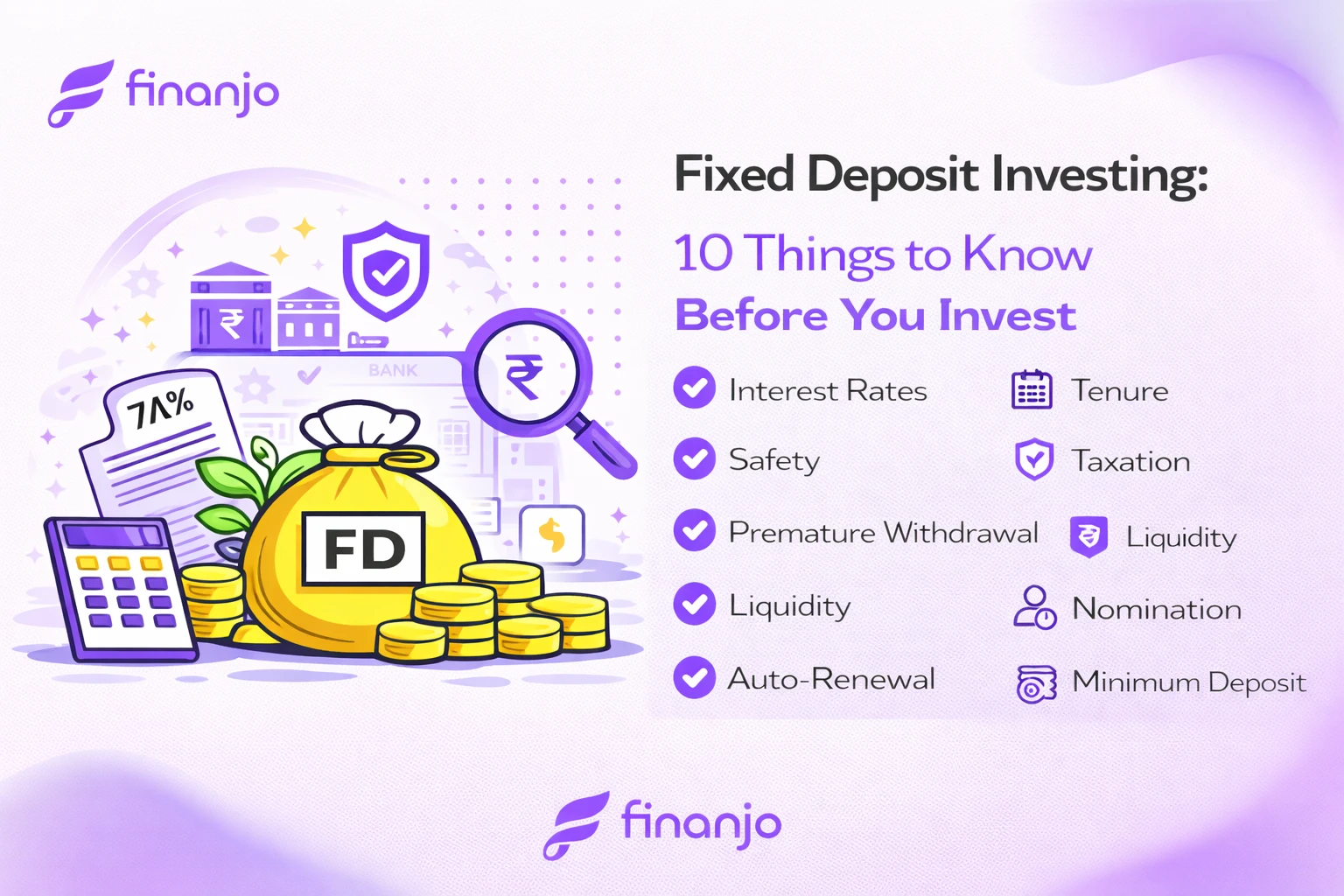
What Is a Fixed Deposit?
A Fixed Deposit (FD) is a traditional investment option offered by banks and NBFCs where an investor deposits a lump-sum amount for a fixed period at a predetermined interest rate.
How Fixed Deposits work
When you invest in an FD, you choose a tenure ranging from a few days to several years. The bank or NBFC pays interest on the deposited amount at a fixed rate, either periodically or at maturity, depending on the FD type. The interest rate is locked in at the time of investment and does not change during the tenure.
Why Fixed Deposits are considered low-risk
Fixed Deposits are considered low-risk because returns are not linked to market movements. Both the principal amount and the interest rate are known in advance, offering predictable returns. When invested with regulated institutions, FDs provide a high level of capital safety compared to market-linked investments.
FD Interest Rates Vary Across Banks and Tenures
Interest rates on Fixed Deposits are not uniform. They differ across banks, NBFCs, and tenures, which is why comparing options before investing is important.
How banks decide FD interest rates
Banks set FD interest rates based on factors such as prevailing interest rate conditions, cost of funds, liquidity requirements, and regulatory considerations. These rates are reviewed periodically and may change with shifts in the broader interest rate environment.
Once an FD is booked, the interest rate remains fixed for the chosen tenure.
Differences across public sector banks, private banks, and NBFCs
Public sector banks generally offer stable but slightly lower FD rates, reflecting their focus on safety and conservative lending.
Private sector banks may offer moderately higher rates to attract deposits, especially for specific tenures.
NBFCs often provide higher FD interest rates compared to banks, as they rely more on deposits for funding, though this comes with relatively higher risk.
Impact of tenure on interest rates
FD interest rates also vary based on tenure length. In many cases, longer tenures offer higher rates, though this is not always linear. Banks may offer peak rates for specific tenures depending on their funding needs.
Choosing the right combination of institution and tenure can help investors optimise returns while staying aligned with their risk comfort.
Returns Are Fixed but Not Always Inflation-Beating
Fixed Deposits are known for predictable returns. However, predictable does not always mean inflation-beating, especially over longer investment periods.
Predictability of FD returns
FD returns are fixed at the time of investment. The interest rate and maturity value are known in advance, which makes FDs suitable for investors who prefer certainty and clear financial planning. Unlike market-linked instruments, FD returns are not affected by market volatility.
Inflation impact on real returns
While FD returns are stable, they may not always keep pace with inflation. If inflation rises faster than the FD interest rate, the real return that is, the return after adjusting for inflation can be low or even negative. This reduces the purchasing power of the invested amount over time.
Why post-tax returns matter
Interest earned on FDs is fully taxable as per the investor’s income tax slab. After accounting for tax, the effective return can be significantly lower than the headline rate. For investors in higher tax brackets, post-tax returns may fall further below inflation, making it important to evaluate FDs on a post-tax, post-inflation basis.
Cumulative vs Non-Cumulative Fixed Deposits
Fixed Deposits can be structured in two main ways based on how interest is paid cumulative and non-cumulative. Understanding the difference helps investors choose the option that matches their cash-flow needs.
Difference between cumulative and non-cumulative FDs
In a cumulative FD, interest is reinvested and compounded over the tenure. The entire interest is paid along with the principal at maturity.
In a non-cumulative FD, interest is paid out at regular intervals, such as monthly, quarterly, half-yearly, or annually, instead of being compounded.
Who should choose cumulative FDs
Cumulative FDs are suitable for investors who:
- Do not need regular income during the FD tenure
- Are investing for long-term or goal-based needs
- Want to benefit from compounding to maximise maturity value
These FDs work well when the objective is wealth accumulation rather than periodic cash flow.
Who should opt for regular interest payouts
Non-cumulative FDs are better suited for investors who:
- Need steady income at regular intervals
- Prefer predictable cash flow from their investment
- Are retirees or individuals relying on FD interest for expenses
While non-cumulative FDs offer convenience, the overall returns may be lower than cumulative FDs due to the absence of compounding.
Lock-In Period and Premature Withdrawal Rules
Before investing in a Fixed Deposit, it is important to understand how FD tenures work and what happens if funds are withdrawn early.
How FD tenures work
Fixed Deposits are offered for predefined tenures, which can range from a few days to several years, depending on the bank or NBFC. The interest rate applicable to an FD is linked to the chosen tenure and is locked in at the time of investment.
Some FDs, such as tax-saving FDs, come with a mandatory lock-in period, while regular FDs generally do not have a strict lock-in.
Penalties for early withdrawal
Most banks allow premature withdrawal of regular FDs, but usually impose a penalty on the interest rate. This penalty is typically a reduction from the applicable rate and varies across institutions.
As a result, the interest earned on an FD withdrawn before maturity may be lower than originally expected.
Exceptions, if any
Certain FD types do not allow premature withdrawal. For example, tax-saving Fixed Deposits have a compulsory lock-in period during which early withdrawal is not permitted. Some banks may also restrict premature withdrawal for specific FD schemes or offer “no premature withdrawal” options at higher interest rates.
Investors should review the terms and conditions carefully before investing, especially if liquidity is a priority.
Taxation of FD Interest
Tax treatment is a key factor to consider when investing in Fixed Deposits, as it directly affects post-tax returns.
Interest taxed as Income from Other Sources
Interest earned from Fixed Deposits is fully taxable and classified as Income from Other Sources under the Income Tax Act. This interest is added to your total income and taxed according to your applicable income tax slab.
The tax treatment applies regardless of whether the interest is paid out periodically or received at maturity.
TDS applicability
Banks may deduct Tax Deducted at Source (TDS) if the total interest earned from all FDs with a bank in a financial year exceeds the prescribed threshold. TDS is deducted at the applicable rate and reflected in Form 26AS.
Eligible investors can submit Form 15G or Form 15H (for senior citizens) to avoid TDS, subject to conditions.
Importance of reporting interest income
Even if TDS is not deducted, FD interest must still be reported while filing the income tax return. Failure to declare interest income can lead to discrepancies and potential tax notices.
Evaluating FDs on a post-tax basis helps investors better assess their actual returns.
Senior Citizen Benefits on Fixed Deposits
Banks offer specific benefits on Fixed Deposits for senior citizens to help improve returns and provide income stability after retirement.
Higher interest rates for senior citizens
Most banks offer additional interest rates to senior citizens on Fixed Deposits. This extra rate is applied over the regular FD interest rate and remains valid for the entire tenure of the deposit.
The higher rate helps senior citizens earn better returns without taking market risk.
Eligibility conditions
Senior citizen FD benefits are generally available to individuals who are 60 years of age or above at the time of opening the FD. The eligibility criteria and additional interest rate offered may vary across banks.
Some banks may also extend benefits to super senior citizens, subject to specific terms.
Special senior citizen FD schemes
Certain banks offer dedicated FD schemes for senior citizens with features such as higher interest rates, longer tenures, or more flexible interest payout options. These schemes are designed to meet the income and stability needs of retirees.
Investors should review scheme-specific terms, including tenure, withdrawal rules, and taxation, before investing.
Deposit Insurance and Safety
Deposit insurance is an important safety feature for Fixed Deposit investors, but it has limits that investors should clearly understand.
Deposit insurance coverage
Deposits held with banks in India are covered under the deposit insurance framework, which provides protection up to a prescribed limit per depositor per bank. This coverage includes the principal amount and accrued interest, subject to the overall cap.
The insurance applies to deposits held with eligible banks, including savings accounts, fixed deposits, and recurring deposits.
What is covered and what is not
Deposit insurance covers deposits up to the specified limit per depositor per bank, regardless of the number of accounts held. Any amount above this limit is not insured.
Deposits placed with NBFCs are generally not covered under deposit insurance. This makes it important for investors to assess the issuer’s credibility when investing in non-bank FDs.
Importance of spreading deposits
To manage risk, investors may consider spreading deposits across multiple banks rather than placing large amounts with a single institution. Diversifying deposits helps ensure that a larger portion of funds remains within the insured limit.
Spreading deposits is particularly relevant for conservative investors and those investing sizeable amounts in Fixed Deposits.
Bank FD vs NBFC FD
Fixed Deposits are offered by both banks and Non-Banking Financial Companies (NBFCs). While the basic structure may look similar, there are important differences in safety, returns, and regulatory protection.
Key differences in safety and returns
Bank FDs are generally considered safer because they are backed by banks with a long operating history and access to deposit insurance up to the prescribed limit. Interest rates on bank FDs are usually moderate and prioritise stability.
NBFC FDs often offer higher interest rates compared to bank FDs. However, these higher returns come with higher credit risk, as NBFC deposits are not covered by deposit insurance.
Regulatory framework
Both banks and NBFCs are regulated by the Reserve Bank of India (RBI), but under different frameworks.
Banks are subject to stricter regulatory norms, including capital adequacy, liquidity requirements, and deposit insurance coverage.
NBFCs are also regulated by the RBI, but their deposits are governed mainly by credit ratings and financial strength, rather than insurance-backed protection.
When NBFC FDs may be considered
NBFC FDs may be considered by investors who:
- Are willing to take slightly higher risk for higher interest rates
- Invest only in highly rated NBFCs
- Do not rely on deposit insurance for capital protection
- Have a diversified FD portfolio across banks and institutions
For risk-averse investors or those prioritising capital safety, bank FDs may be more suitable. NBFC FDs work better as a supplement, not a replacement, for bank FDs.
Liquidity and Loan Against FD
Liquidity is an important consideration when investing in Fixed Deposits, especially for investors who may need access to funds before maturity.
Premature withdrawal vs loan facility
Most regular FDs allow premature withdrawal, but this usually comes with an interest penalty. The bank may reduce the applicable interest rate, which lowers overall returns.
As an alternative, many banks offer a loan or overdraft facility against an FD. This allows investors to access funds without breaking the deposit, helping preserve the original interest rate.
How loans against FDs work
A loan against an FD is typically offered as a percentage of the FD value, usually up to a specified limit. The FD continues to earn interest at the original rate, while the loan is charged interest at a slightly higher rate.
Since the FD itself acts as collateral, the loan process is usually faster and requires minimal documentation.
When liquidity matters
Liquidity becomes important when funds may be needed for short-term or unexpected expenses. Investors who anticipate such needs should consider FDs with flexible withdrawal rules or confirm the availability of a loan facility before investing.
Understanding liquidity options helps investors avoid unnecessary penalties and manage cash flow more effectively.
Aligning FD Investment with Financial Goals
Fixed Deposits are most effective when they are aligned with specific financial goals rather than used as a one-size-fits-all investment.
Matching tenure with goals
Choosing the right FD tenure is essential. The investment period should match the timeline of the financial goal. Shorter tenures may suit near-term needs, while longer tenures can be used when funds are not required immediately.
Locking funds for longer than necessary can reduce liquidity, while choosing very short tenures may limit returns.
Using FDs for short-, medium-, and long-term needs
FDs are commonly used for:
- Short-term needs, such as emergency funds or upcoming expenses, where safety and quick access are priorities
- Medium-term goals, such as planned purchases or education-related expenses, where return certainty is important
- Long-term needs, primarily for capital preservation, especially for conservative investors
However, over very long periods, investors should be mindful of inflation’s impact on real returns.
Role of FDs in a diversified portfolio
FDs play a stabilising role in a diversified portfolio. They provide predictable returns and capital protection, helping balance riskier investments such as equities or market-linked products.
Used appropriately, FDs can improve overall portfolio stability while ensuring liquidity and financial clarity.
FAQs on Fixed Deposit Investing
1. Is an FD better than a savings account?
A Fixed Deposit generally offers higher interest rates than a regular savings account, making it more suitable for funds that are not needed immediately. However, savings accounts provide greater liquidity, while FDs are better for planned investments with a defined tenure.
2. Are Fixed Deposits completely risk-free?
Fixed Deposits are considered low-risk investments, especially when placed with regulated banks. Returns are fixed and not linked to market movements. However, they are not entirely risk-free, as deposit insurance applies only up to the prescribed limit and does not cover amounts beyond that.
3. How do I choose the right FD tenure?
The right FD tenure depends on your financial goals and liquidity needs. Short tenures suit near-term requirements, while longer tenures work better for funds that can remain invested. Matching the tenure with the goal timeline helps avoid premature withdrawals.
4. Is FD interest taxable every year?
Yes. Interest earned on Fixed Deposits is fully taxable and taxed as Income from Other Sources. It must be reported in your income tax return every year, even if the interest is received at maturity in the case of cumulative FDs.
5. Should I invest in multiple FDs?
Investing in multiple FDs can help manage liquidity and risk. Staggering deposits across tenures or institutions allows easier access to funds and reduces concentration risk, especially for larger investment amounts.
Leave a Reply