Fixed Deposit vs Recurring Deposit ( FD vs RD ): Which is better when you want safe returns but aren’t sure how to plan your savings efficiently? If you’re a salaried professional, a first-time investor, or someone trying to balance monthly expenses with long-term financial goals, choosing between a Fixed Deposit and a Recurring Deposit can feel confusing. This is especially true when interest rates and tax rules come into play.
This blog will help you clearly understand the difference between FD and RD, how returns and taxation work for each, and which option suits your income pattern and investment horizon so you can make a confident, tax-efficient decision without overcomplicating your finances.
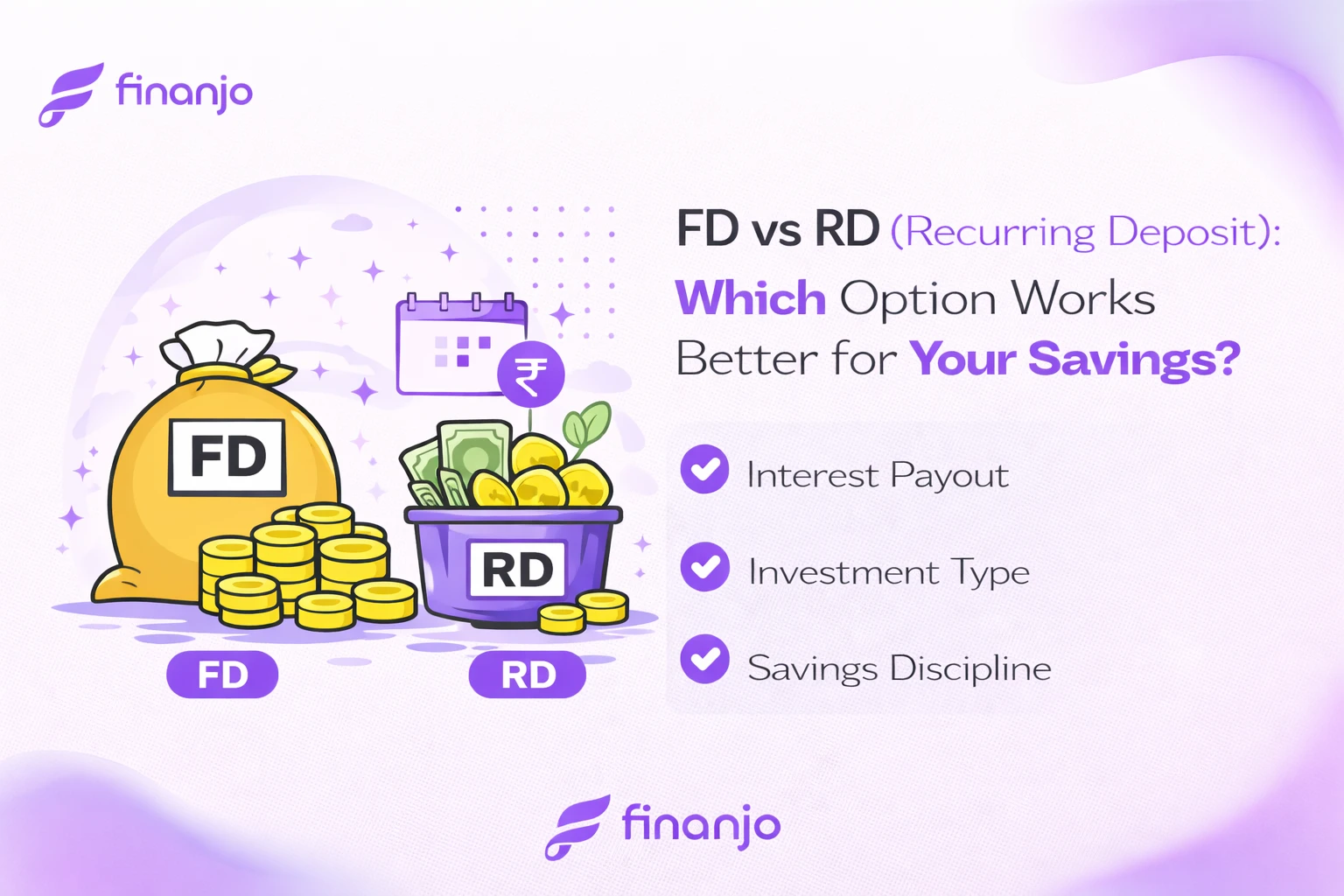
What is a Fixed Deposit (FD)?
A Fixed Deposit (FD) is a traditional investment option offered by banks and NBFCs where you invest a lump-sum amount for a fixed period at a predetermined interest rate. The interest rate remains unchanged throughout the tenure, making FDs a preferred choice for investors who value certainty over higher but volatile returns.
How does an FD work?
When you open an FD, you deposit a one-time amount for a chosen tenure ranging from a few days to several years. The bank pays interest on this amount at a fixed rate, either periodically or at maturity. Since the rate is locked in at the time of investment, your returns are not affected by market fluctuations.
FD interest payout options
FDs offer flexibility in how interest is received. You can choose:
- Cumulative FDs, where interest is compounded and paid at maturity
- Non-cumulative FDs, where interest is paid out monthly, quarterly, half-yearly, or annually
This helps investors align FD income with their cash flow needs.
Who should consider an FD?
A Fixed Deposit is suitable for:
- Investors looking for capital protection and predictable returns
- Individuals with a lump-sum amount to invest
- Those planning for short- to medium-term financial goals
- Retirees or conservative investors seeking regular income
What is a Recurring Deposit (RD)?
A Recurring Deposit (RD) is a savings-focused investment option offered by banks and post offices that allows you to invest a fixed amount every month for a pre-defined tenure at a fixed interest rate. RDs are designed to help individuals build savings gradually, without the need for a lump-sum investment.
How does an RD work?
In an RD, you commit to depositing a fixed sum usually starting from as low as ₹500 every month for a chosen tenure, typically ranging from 6 months to 10 years. Each monthly deposit earns interest from the date it is invested until maturity. Missing deposits may attract a small penalty, reinforcing regular saving discipline.
RD interest calculation basics
Interest on an RD is calculated using the compound interest method, similar to Fixed Deposits. However, since each monthly instalment is invested for a different duration, the total interest earned is slightly lower than a lump-sum FD of the same total amount. The final maturity value depends on the deposit amount, tenure, interest rate, and compounding frequency.
Who should consider an RD?
A Recurring Deposit is suitable for:
- Salaried individuals with regular monthly income
- First-time or conservative investors starting their savings journey
- Individuals saving for short- to medium-term goals
- Those who want to build savings without market risk
RDs are ideal for investors who prefer a systematic and disciplined approach to saving, while still benefiting from fixed returns and predictable maturity value.
FD vs RD: Key Differences
Choosing between an FD and an RD becomes easier when you compare them across key features that directly affect returns, liquidity, and tax impact. The table below highlights the main differences between Fixed Deposits and Recurring Deposits to help you decide which option aligns better with your savings needs.
| Feature | Fixed Deposit (FD) | Recurring Deposit (RD) |
|---|---|---|
| Investment amount | One-time lump-sum investment | Fixed amount invested every month |
| Deposit frequency | Single deposit at the time of opening | Monthly deposits throughout the tenure |
| Interest rates | Generally slightly higher than RD rates for similar tenures | Slightly lower than FD rates |
| Tenure | Ranges from 7 days to 10 years (varies by bank) | Typically 6 months to 10 years |
| Liquidity & premature withdrawal | Premature withdrawal allowed, usually with a penalty | Early closure allowed; penalties may apply for missed or withdrawn instalments |
| Taxation | Interest is fully taxable as per income tax slab; TDS applicable | Interest is taxable as per income tax slab; TDS rules apply |
| Best suited for | Investors with surplus funds seeking predictable returns | Individuals looking to save systematically from regular income |
This comparison makes it clear that while both FDs and RDs offer safety and assured returns, the choice largely depends on how you earn and save money, and how much flexibility you need during the investment period.
FD vs RD: Returns Comparison With Example
While both Fixed Deposits and Recurring Deposits offer assured returns, the way money is invested and therefore compounded differs. Understanding this difference is important when comparing the final maturity value.
FD returns example (lump-sum investment)
Suppose you invest ₹1,20,000 in a Fixed Deposit for 1 year at an interest rate of 7% per annum, compounded quarterly.
- Investment amount: ₹1,20,000
- Tenure: 1 year
- Interest rate: 7% p.a.
At the end of the tenure, the maturity amount would be approximately ₹1,28,700.
Since the entire amount is invested from day one, it earns interest for the full tenure, resulting in higher overall returns.
RD returns example (monthly contribution)
Now consider investing the same total amount ₹1,20,000through a Recurring Deposit by contributing ₹10,000 per month for 12 months at 7% per annum.
- Monthly deposit: ₹10,000
- Tenure: 12 months
- Interest rate: 7% p.a.
Because each monthly instalment is invested for a different duration, the maturity amount would be approximately ₹1,24,500.
Even though the interest rate is the same, the returns are lower than an FD because the money is not invested upfront.
How compounding differs in FD and RD
In an FD, the entire principal benefits from compounding for the full tenure. In contrast, an RD involves staggered investments, where earlier deposits earn interest longer than later ones. This difference in compounding is the primary reason FDs typically generate higher returns than RDs for the same total investment and tenure.
What affects actual returns
The final returns from both FDs and RDs depend on several factors, including:
- Interest rate offered by the bank or NBFC
- Tenure of the deposit
- Compounding frequency
- Timing and consistency of RD deposits
- Premature withdrawal penalties
While FDs are more return-efficient for lump-sum investments, RDs are better suited for disciplined monthly savings, even if the absolute returns are lower.
FD vs RD: Taxation Rules Explained
Taxation is a key factor when choosing between a Fixed Deposit and a Recurring Deposit, as it directly impacts the returns you actually take home. While both are low-risk investment options, the interest earned on FDs and RDs is fully taxable, and the tax treatment is largely similar.
How FD interest is taxed
Interest earned on a Fixed Deposit is taxed as Income from Other Sources. This means it is added to your total income and taxed according to your income tax slab.
Banks deduct TDS at 10% if the total interest earned from all FDs with a bank in a financial year exceeds:
• ₹40,000 for individuals
• ₹50,000 for senior citizens
If your total income is below the basic exemption limit, you can submit Form 15G (or Form 15H for senior citizens) to prevent TDS deduction.
However, it is important to note that TDS deduction does not decide tax liability. Even if no TDS is deducted, FD interest must still be reported while filing your income tax return.
How RD interest is taxed
The interest earned on a Recurring Deposit is also fully taxable and treated as income from other sources. Although RD interest is usually received at maturity, it is taxable on an accrual basis, meaning it should be reported each year as it accrues.
Banks may deduct TDS on RD interest if the total interest earned crosses the applicable threshold. As with FDs, the absence of TDS does not mean the income is tax-free.
TDS rules on FD and RD
TDS is calculated on the aggregate interest earned from all deposits held with a bank, not on individual FDs or RDs. If TDS is deducted, it will appear in Form 26AS, and you can adjust it while filing your income tax return.
It is important to remember that TDS is not the final tax liability. If your tax slab rate is higher than 10%, you may have to pay additional tax. If it is lower, you can claim a refund.
Section 80C tax-saving FD: where it fits
A tax-saving Fixed Deposit with a lock-in period of 5 years qualifies for a deduction under Section 80C, subject to the overall limit of ₹1.5 lakh. However:
- The interest earned is still fully taxable
- Premature withdrawal is not allowed during the lock-in period
- Recurring Deposits do not qualify for Section 80C benefits
In short, while FDs and RDs offer assured returns, they are not tax-free investments. Factoring in your tax slab before investing can help you make a more informed and tax-efficient choice.
PRESS RELEASE: Section 80C of the Income-tax Act
FD vs RD: Which Is Better for Different Investors?
There is no one-size-fits-all answer when choosing between an FD and an RD. The right option depends on your income pattern, savings behaviour, and the time horizon of your financial goals.
Here’s how FDs and RDs suit different types of investors.
For salaried individuals
Salaried individuals with a regular monthly income often find Recurring Deposits more suitable. An RD allows them to set aside a fixed amount every month without disrupting household expenses, while still earning assured returns. FDs, on the other hand, may work better when there is a bonus or surplus lump sum to invest.
For self-employed professionals
For self-employed individuals, income can be irregular. In such cases, Fixed Deposits offer more flexibility, as they allow investment whenever surplus funds are available. RDs may be less convenient due to the commitment of fixed monthly deposits, especially during months with uneven cash flow.
For first-time investors
First-time or conservative investors often benefit from starting with a Recurring Deposit. RDs encourage disciplined saving, require a lower monthly commitment, and help investors get comfortable with fixed-income products before moving on to larger investments like FDs.
For short-term goals
For short-term financial goals such as building an emergency fund or saving for an upcoming expense Fixed Deposits are generally more effective. Since the entire amount is invested upfront, FDs tend to offer better returns over shorter tenures and provide predictable maturity value.
For long-term goals
For longer-term goals, both FDs and RDs can play a role depending on how the investment is structured. RDs are useful for gradually accumulating funds over time, while FDs work better once a sizeable corpus has been built. In practice, many investors use RDs to save and later convert the maturity amount into an FD for better compounding.
Overall, the choice between FD and RD should be guided by how you earn, how you save, and when you need the money, rather than just the interest rate offered.
When FD is a Better Choice ?
A Fixed Deposit is often the preferred option when you have a lump sum to invest and are looking for certainty in returns. While RDs help build savings gradually, there are situations where an FD works more effectively.
Situations where FD works better than RD
An FD is a better choice when you already have surplus funds available upfront, such as a bonus, maturity proceeds from another investment, or savings parked in a low-interest account. Since the entire amount is invested from the beginning, it benefits from compounding for the full tenure, leading to relatively higher returns compared to an RD with the same total investment.
FDs also work better when you want to lock in current interest rates, especially in a falling rate environment. Once booked, the rate remains fixed for the entire tenure.
Ideal financial goals for FD
Fixed Deposits are well-suited for:
- Short- to medium-term goals with a defined timeline, such as higher education fees or a planned purchase
- Parking funds meant for capital protection, where safety is a priority
- Creating a stable income source for retirees or conservative investors
Their predictable maturity value makes FDs easier to align with goal-based planning.
Liquidity and income needs
FDs offer better flexibility when it comes to liquidity and income planning. Most banks allow premature withdrawal, though a small penalty may apply. Additionally, non-cumulative FDs provide regular interest payouts, making them suitable for those who need periodic income.
Overall, an FD is a better choice when you prioritise return efficiency, income certainty, and flexibility, and do not need the structure of monthly savings that an RD provides.
When RD is a Better Choice ?
A Recurring Deposit is better suited for investors who prefer to save gradually rather than invest a lump sum. It is designed to make regular saving a habit, especially when monthly income is predictable.
Situations where RD works better than FD
An RD works better when you do not have surplus funds available upfront but can comfortably set aside a fixed amount every month. This is often the case for salaried individuals or those at the beginning of their careers. RDs also suit investors who want to avoid the temptation of spending excess cash by committing to a structured savings plan.
Importance of savings discipline
One of the key advantages of an RD is the discipline it brings to saving. Since a fixed amount is deposited every month, it encourages consistency and long-term planning. Missing deposits may attract penalties, which further reinforces regular contributions and helps build a steady savings habit.
Goal-based monthly investing
Recurring Deposits are well-suited for goal-based savings, such as building an emergency fund, planning a vacation, or saving for a short-term expense. By linking a specific monthly amount to a defined goal and tenure, RDs make financial planning more manageable and predictable.
Overall, an RD is a better choice when the focus is on systematic saving, affordability, and financial discipline, rather than maximising returns from a lump-sum investment.
FD vs RD: Things to Consider Before Investing
Before choosing between a Fixed Deposit and a Recurring Deposit, it is important to look beyond interest rates. Several practical factors can influence both returns and flexibility over the investment period.
Interest rate cycles
Interest rates offered on FDs and RDs vary over time. If interest rates are expected to fall, locking in an FD at current rates may be beneficial. In a rising rate environment, shorter tenures or staggered investments through RDs can offer more flexibility to reinvest at higher rates later.
Tax slab impact
Since interest from both FDs and RDs is fully taxable, your income tax slab plays a significant role in determining post-tax returns. Investors in higher tax brackets may find that the effective returns are considerably lower, making it important to assess whether the assured returns justify the tax outgo.
Inflation effect
While FDs and RDs protect capital, their returns may not always keep pace with inflation. Over longer periods, inflation can reduce the real value of your returns. These deposits are therefore better suited for short- to medium-term goals rather than long-term wealth creation.
Premature withdrawal rules
Both FDs and RDs allow premature withdrawal, usually with a penalty. However, the rules differ across banks and NBFCs. In RDs, missed monthly deposits may also attract penalties. Understanding these conditions in advance helps avoid unexpected costs.
Bank vs NBFC deposits
Banks generally offer higher safety and easier liquidity, while NBFC deposits may provide slightly higher interest rates. However, NBFC deposits come with higher risk and may have stricter withdrawal terms. It is important to evaluate the credit rating and reliability of the institution before investing.
Taking these factors into account can help you choose between FD and RD in a way that balances returns, safety, and flexibility.
Final Verdict: FD vs RD – Which Should You Choose?
There is no clear winner when choosing between a Fixed Deposit and a Recurring Deposit. Both serve different purposes and work best in different situations.
If you have a lump sum available and are looking for predictable returns over a defined period, a Fixed Deposit may be the better option. On the other hand, if you prefer saving gradually from regular income and want to build a disciplined savings habit, a Recurring Deposit may be more suitable.
In simple terms:
- Choose an FD if you have surplus funds and want better return efficiency over a fixed tenure.
- Choose an RD if you want to save systematically from monthly income.
Many investors use both starting with an RD to build savings and later moving the accumulated amount into an FD.
Ultimately, the right choice depends on your cash flow, financial goals, and comfort with liquidity, rather than just the interest rate.
FAQs on FD vs RD
1. Is RD better than FD for monthly savings?
Yes, an RD is generally better for monthly savings. It allows you to invest a fixed amount every month and helps build a disciplined saving habit. An FD is more suitable when you have a lump sum to invest rather than monthly surplus income.
2. Is FD safer than RD?
No, FDs and RDs carry a similar level of safety when offered by the same bank or institution. Both are fixed-income products with assured returns, and the risk depends on the financial strength of the bank or NBFC, not on the deposit type.
3. Which gives higher returns FD or RD?
For the same total investment, tenure, and interest rate, an FD usually gives higher returns than an RD. This is because the entire amount in an FD is invested upfront and earns interest for the full tenure, whereas RD deposits are made in instalments.
4. Is RD interest taxable every year?
Yes, RD interest is taxable every year on an accrual basis, even though the interest is received at maturity. It must be declared as income from other sources while filing your income tax return.
5. Can I have both FD and RD at the same time?
Yes, you can invest in both an FD and an RD at the same time. Many investors use RDs to save regularly and later convert the accumulated amount into an FD for better return efficiency.
Leave a Reply